HBM3

CXMT
2026-07-27 13:30:00

CXMT Debuts on STAR Market With RMB 3.35 Trillion Intraday Value After Years of Losses

Chinese DRAM maker ChangXin Memory Technologies, or CXMT, officially listed on Shanghai’s STAR Market on July 27, 2026, reaching an intraday market capitalization of about RMB 3.35 trillion, according to 8Marketcap. The valuation is a sharp jump from its IPO value of RMB 579.2 billion and comes despite accumulated uncovered losses of RMB 36.65 billion as of the end of 2025. The company’s turnaround story traces back to the 2016 launch of the “506” domestic DRAM project in Hefei under the leadership of GigaDevice founder Zhu Yiming, backed by Hefei state capital and later a mix of brokers, market investors, bank-affiliated AIC funds, and internet companies. After years of heavy spending on fabs, process development, and yield improvement, CXMT posted a first-quarter 2026 revenue of RMB 50.8 billion and attributable net profit of RMB 24.762 billion, helped by a surge in DRAM contract prices and AI-related memory demand. The report also notes that the valuation carries substantial domestic substitution and AI premium, while process gaps, higher bit costs, customer concentration, and remaining historical losses still weigh on the company’s longer-term fundamentals.

1400
CXMT Debuts on STAR Market With RMB 3.35 Trillion Intraday Value After Years of Losses
CXMT
2026-07-27 02:57:09

Nomura Starts Coverage on CXMT With a RMB 116 Target, Built on Aggressive AI Memory Assumptions

Nomura has initiated coverage on Chinese DRAM maker ChangXin Memory Technologies, or CXMT, with a Buy rating and a target price of RMB 116, according to a report discussed in a ChainCatcher article by “The Dream of the Fourth Dimension.” The front page of the report also showed an IPO price of RMB 8.66 and implied upside of 1,239.5%, making it, in the author’s view, the most aggressive target price so far from a foreign institution on the company. The target is based on 20x projected 2028 earnings per share of about RMB 5.8. Nomura anchors that multiple to Micron’s historical forward valuation range, then adds what it sees as an A-share premium using ACM Research Shanghai versus its U.S.-listed parent as a reference. The report also projects a steep jump in revenue, net profit attributable to shareholders, gross margin, cash, and return on equity through 2028. Its broader thesis rests on rising memory demand from agentic AI, supply bottlenecks across cleanrooms, tools, materials and engineers, and CXMT’s own capacity ramp, yield improvement, and share gains. The original article, however, argues that the model’s most aggressive assumption is gross margin reaching 83.7% in 2026 and more than 90% by 2028, and suggests the figures are better read as an upside case than a long-term midpoint.

1340
Nomura Starts Coverage on CXMT With a RMB 116 Target, Built on Aggressive AI Memory Assumptions
AI Inference
2026-07-23 09:42:12

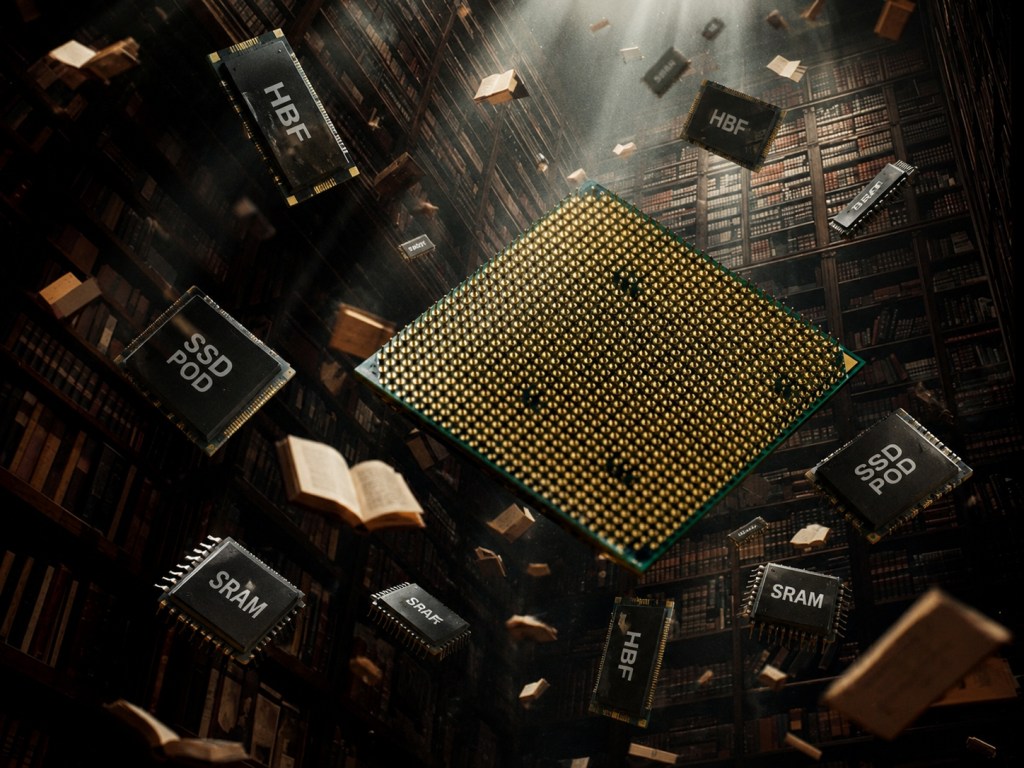
AI inference shifts the memory stack as HBF, SSD POD and SRAM take on new roles

A TrendForce research note says the memory hierarchy behind AI systems is being redrawn as the industry shifts from training to inference. High Bandwidth Memory, or HBM, dominated the training era because it solved a bandwidth problem. In inference, the pressure point has changed. Key-value cache growth during prefill and decode is pushing capacity to the forefront, creating room for three different approaches: HBF for larger-capacity memory between HBM and SSD, SSD POD for offloading cache into lower-cost storage tiers, and SRAM for ultra-fast on-chip access in decode-heavy workloads. The report walks through how each technology fits into the stack rather than framing them as direct substitutes. HBF, being developed by SanDisk and SK hynix, is aimed at much larger capacity than HBM but has not reached mass production. NVIDIA’s SSD POD concept, tied to its Dynamo framework and NIXL transport library, is designed to move KV cache from limited GPU memory into CPU RAM, local SSDs, and remote storage without stopping inference. SRAM, used aggressively by companies such as Groq and Cerebras, trades capacity for speed by keeping memory on chip. The piece also points to recent product moves from NVIDIA, Google, SambaNova, Cerebras and Etched as evidence that inference-focused hardware design is accelerating.

1160
AI inference shifts the memory stack as HBF, SSD POD and SRAM take on new roles