IDM

CXMT
2026-09-08 04:07:58

CXMT's LPDDR6 Enters Mass Production, Apple Partnership Awaits US Approval, Domestic DUV Progresses

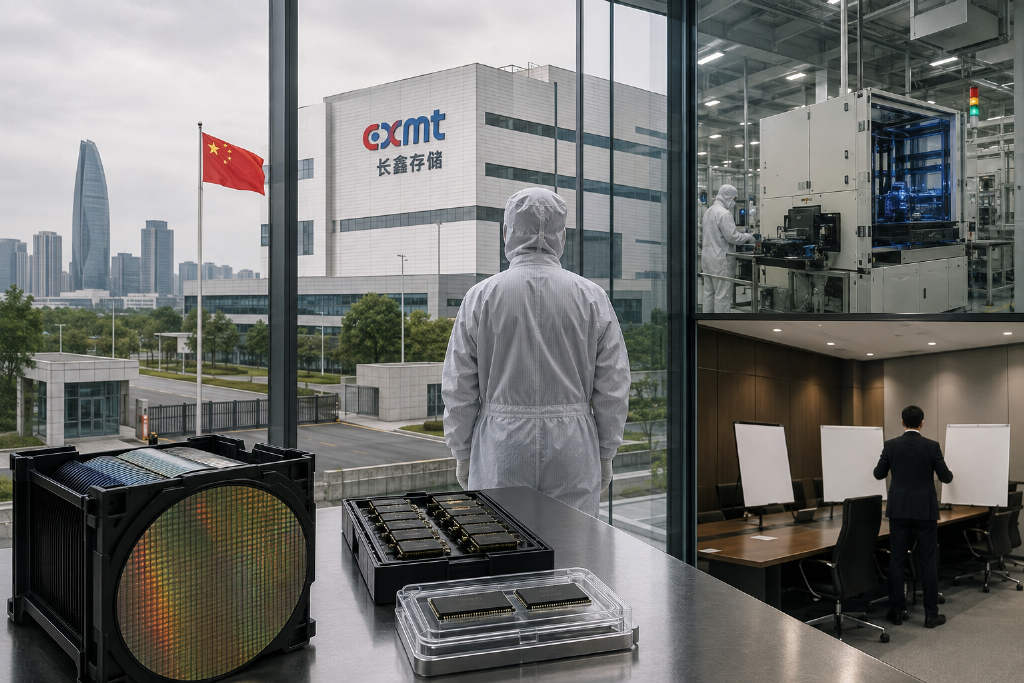
China's largest DRAM maker CXMT held its H1 2026 earnings call on September 7, revealing a 873.6% revenue surge and 84.8% gross margin. The company announced mass production of its self-developed LPDDR6 memory, debuting on Xiaomi's 18 Fold flagship. On Apple partnership rumors, management neither confirmed nor denied, but industry sources indicate product qualification is complete, pending US government approval. CXMT also disclosed progress in domestic DUV lithography tool validation and outlined its HBM roadmap remains undisclosed. Customer concentration is high but manageable, with IDM flexibility to weather cycles.

80
CXMT's LPDDR6 Enters Mass Production, Apple Partnership Awaits US Approval, Domestic DUV Progresses
Jiangbolong
2026-09-08 03:56:08

Jiangbolong Lists in Hong Kong at HK$236 a Share, Completing A+H Structure With Market Value Near HK$107.5 Billion

Jiangbolong made its debut on the Hong Kong Stock Exchange main board on Sept. 8, completing its A+H listing structure after already trading in Shenzhen. The company priced its H shares at HK$236 and sold 26.0778 million shares globally, raising about HK$6.136 billion. At the opening price, its market capitalization stood at roughly HK$107.5 billion, while its A-share market value was about RMB 154 billion. Founded by Jiangxi-born twin siblings Cai Huabo and Cai Lijiang, Jiangbolong grew from a small memory counter in Shenzhen’s Huaqiangbei into what the article described as the world’s second-largest independent semiconductor memory company. Its prospectus showed first-half 2026 revenue of RMB 24.088 billion, up 136.26% year over year, and net profit attributable to shareholders of RMB 10.577 billion, up 71,528.66%. The report also highlighted the tension behind that surge. Gross margin climbed to 58.2% in the first half, helped by rising memory prices, but operating cash flow was negative RMB 3.151 billion, inventory reached RMB 25.777 billion, and total short- and long-term borrowings exceeded RMB 15.4 billion. The company said the Hong Kong proceeds will go to research and development, strategic investments and acquisitions, and working capital as it pushes further upstream into chip design and supply-chain integration.

130
Jiangbolong Lists in Hong Kong at HK$236 a Share, Completing A+H Structure With Market Value Near HK$107.5 Billion
YMTC
2026-09-04 02:56:14

YMTC Holding moves into STAR Market inquiry stage with record 33 billion yuan IPO plan

Yangtze Memory Technologies Holding Co., Ltd., or YMTC Holding, has moved a step further in its planned listing on Shanghai’s STAR Market. The Shanghai Stock Exchange website showed on Sept. 3 that the company’s IPO review status changed from "accepted" to "under inquiry," just 13 days after its application was accepted on Aug. 21. The company plans to raise 33 billion yuan, a figure that would set a new record for proposed fundraising on the STAR Market, topping ChangXin Memory Technologies’ 29.5 billion yuan and Semiconductor Manufacturing International Corp.’s 20 billion yuan. CITIC Securities and CSC Financial are serving as joint sponsors. According to Counterpoint Research, YMTC Holding reached a 14% share of global NAND bit shipments in the second quarter of 2026, surpassing Kioxia and Micron for the first time and ranking third worldwide behind Samsung Electronics at 25% and SK hynix at 22%. Shipment volume rose 22% year over year. The prospectus also shows that the company’s second-phase production line is already running at full capacity, while construction of a third-phase project is advancing. Of the funds to be raised, 20.8 billion yuan is earmarked for production line technology upgrades and 12.2 billion yuan for research and development-related projects.

210
YMTC Holding moves into STAR Market inquiry stage with record 33 billion yuan IPO plan
Xinliu Weilan
2026-09-01 10:05:08

Zhejiang University researcher Sun Qi-led Xinliu Weilan raises first funding round

Hangzhou-based Xinliu Weilan Intelligent Technology, an AI-for-IC design startup, has completed its first funding round worth tens of millions of yuan, with Qigao Capital as the sole investor. The company was founded in 2026 by Zhejiang University researcher Sun Qi, who set out to combine artificial intelligence with electronic design automation, or EDA, to build a new generation of intelligent chip design tools. According to the company, its system has already run through the full physical design flow in real-world projects below the 10nm node and at a scale of nearly 10 million gates, while continuing to improve PPA metrics covering performance, power and area. The startup says its product stack includes an in-house IC design model called Wavelet and an engineering workflow control system named Orbit, designed to support long-running, cross-tool and cross-stage tasks. The article, originally published by WeChat account Touzijie AI and written by Yu Mengying, also cited comments from Qigao Capital founder and managing partner Dr. Zhang Yong, who said chip design is moving from tool automation toward process-level intelligence centered on large models and agents.

150
Zhejiang University researcher Sun Qi-led Xinliu Weilan raises first funding round
ChangXin
2026-08-28 10:12:02

DRAM Maker ChangXin Reports 873.64% H1 Revenue Surge, RMB 77.6B Net Profit

ChangXin Technology released its 2026 interim report, posting H1 revenue of RMB 150.31 billion, up 873.64% year-on-year, and net profit attributable to shareholders of RMB 77.61 billion, reversing a net loss of RMB 2.33 billion a year earlier. Operating cash flow reached RMB 131.16 billion, surging 2,985.64%. Gross margin stood at 84.84%, with R&D spending of RMB 6.86 billion, or 4.56% of revenue. Total assets reached RMB 468.08 billion, with net assets of RMB 270.75 billion. The company, the world's fourth-largest and China's largest DRAM IDM, supplies DDR5, LPDDR5/5X and LPDDR6 products to clients including Alibaba Cloud, ByteDance, Tencent, Lenovo, Xiaomi, OPPO and vivo. As of June 30, it held 4,484 domestic and 3,400 overseas patents, with 7,491 R&D staff accounting for 33.42% of headcount. ChangXin has no controlling shareholder or de facto controller; its largest shareholder, Qinghui Jidian, holds a 21.67% stake. The company listed on the STAR Market on July 27 at RMB 8.66 per share, with market cap surpassing RMB 3.5 trillion on its first trading day.

220
DRAM Maker ChangXin Reports 873.64% H1 Revenue Surge, RMB 77.6B Net Profit
YMTC
2026-08-27 00:56:21

Yangtze Memory files for STAR Market IPO after CXMT rally, but its path differs

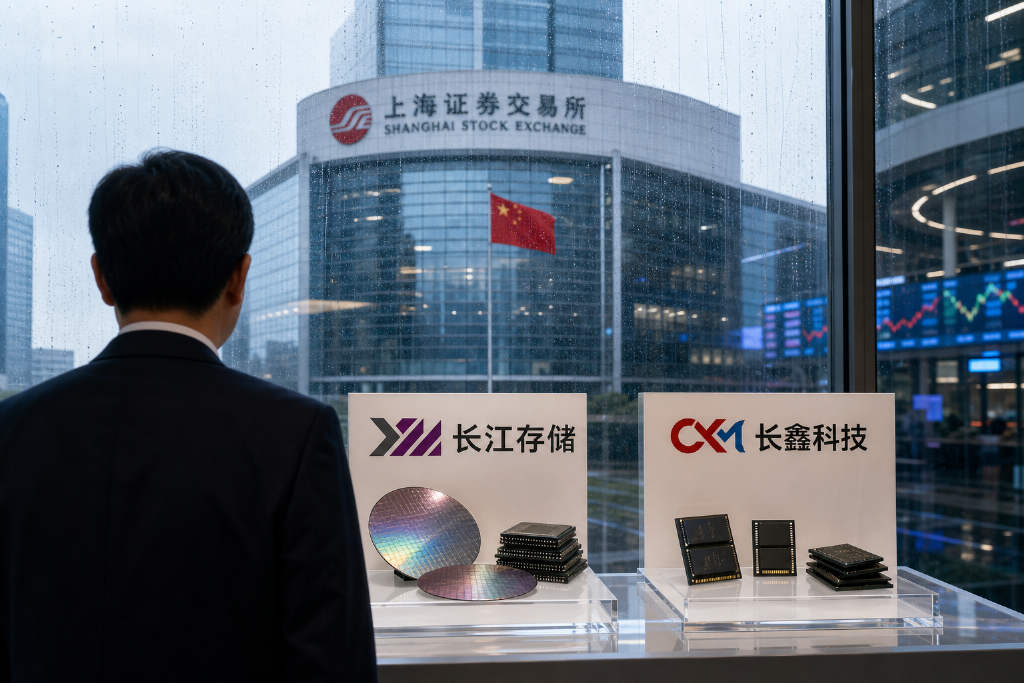
Yangtze Memory Technologies Co. (YMTC) has had its IPO application accepted by the Shanghai Stock Exchange’s STAR Market, with plans to raise 33 billion yuan, topping the 29.5 billion yuan target set by CXMT and marking the largest proposed fundraising deal in the board’s history. The filing arrives about a month after CXMT’s debut, when the DRAM maker’s market value jumped from roughly 579.2 billion yuan at issue to 3.28 trillion yuan by the close of its first trading day. The comparison has quickly centered on whether YMTC, another leading Chinese memory maker, can see a similar post-listing surge. The source article argues that the two companies share some structural similarities — both were founded in 2016, both operate under the IDM model, and neither has a controlling shareholder or actual controller — but differ sharply in product focus, market size, industry structure, and valuation logic. CXMT is focused on DRAM, a segment tied closely to AI memory demand and still dominated by Samsung Electronics, SK hynix, and Micron Technology. YMTC is centered on NAND Flash, which serves long-term storage use cases and faces a more fragmented competitive field. Analysts cited by Zhongxin Jingwei said those differences matter for IPO pricing, investor sentiment, and the odds of repeating CXMT’s first-day market performance.

380
Yangtze Memory files for STAR Market IPO after CXMT rally, but its path differs
Semiconductor
2026-08-24 11:55:11

Used semiconductor tools gain strategic weight as mature-node demand stays firm

Used semiconductor equipment is moving from a low-cost backup option to a core asset in mature-node chip manufacturing, as demand for automotive power devices, industrial control chips, analog chips, IoT MCUs and sensor chips remains strong. The article says many of these products continue to rely on 90nm to 28nm processes, while advanced-node development costs, tape-out fees and equipment spending keep rising and the performance gains from each generation narrow. According to the source, the global market for used semiconductor equipment exceeded 26 billion yuan in 2024 and could approach 66.5 billion yuan by 2031, implying a six-year compound annual growth rate of 14.4%. Supply conditions have also changed. Major chipmakers that once released retired tools into the secondary market are now keeping older equipment for internal process conversions, niche capacity expansion and maintenance, reducing the pool of tradable assets. The report also points to a structural mismatch inside the industry. Semiconductor manufacturing requires extreme precision and standardization, but the used-equipment trade still lacks unified grading standards, testing rules, warranty systems and credible third-party inspection institutions. At the same time, tighter global controls have expanded from advanced equipment and technology to retired tools, refurbished systems, spare parts, calibration services and firmware updates, making used tools a more important part of supply-chain security planning.

430
Used semiconductor tools gain strategic weight as mature-node demand stays firm
Goldman Sachs
2026-08-24 07:01:09

Goldman Sachs lifts China semiconductor capex forecast to $82 billion by 2030

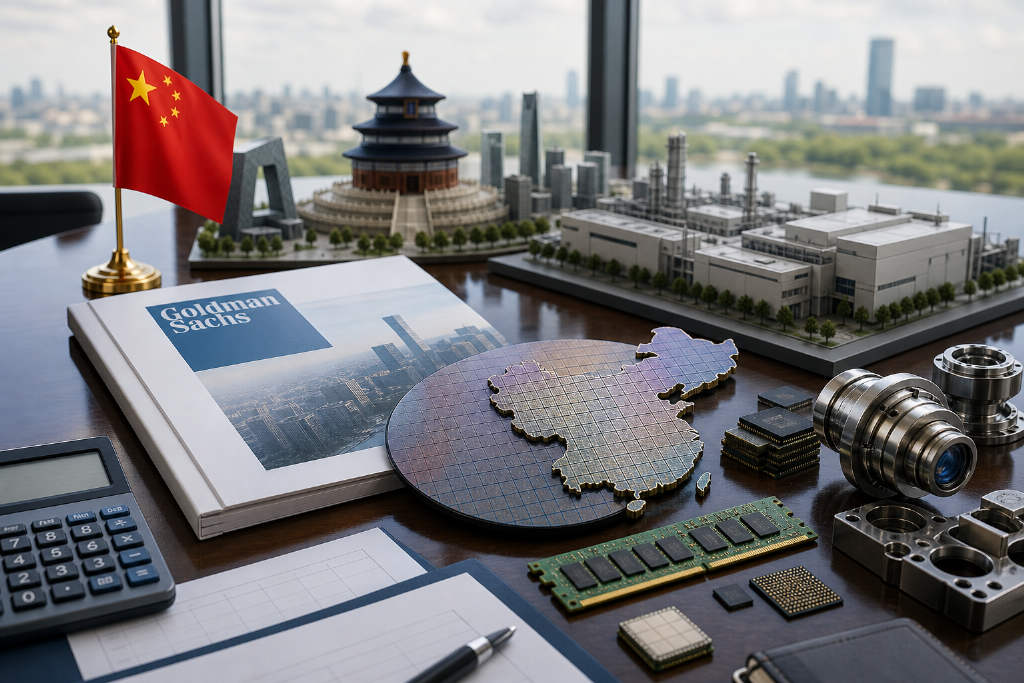
Goldman Sachs said in its fourth annual report in the “Chip Act” series, released on Aug. 24, that China’s semiconductor IC self-sufficiency rate by unit volume had reached 70% as of June 2026, up from 38% in January 2010. The bank said the gap in value-based self-sufficiency remains large, with lithography equipment still the main bottleneck. Against that backdrop, Goldman raised its forecast for China’s semiconductor capital expenditure in 2030 to $82 billion, a 79% increase from its previous estimate, citing stronger demand tied to higher self-sufficiency, generative AI and customer localization strategies. The report also initiated coverage on Chinese DRAM maker CXMT with a Buy rating and a target price of 129 yuan. Goldman’s base-case estimate puts China’s AI chip total addressable market at $678 billion by 2030, while it sees the country’s DRAM market reaching $257 billion by 2028. The bank also expects domestic equipment vendors to increase their share of China’s WFE market, even as overseas suppliers remain important in advanced-node manufacturing.

630
Goldman Sachs lifts China semiconductor capex forecast to $82 billion by 2030