ZTE

Taorun Semico
2026-08-13 07:42:11

Taorun Semiconductor files for IPO tutoring as early backer Xia Zuoquan edges closer to a fifth listed company

Taorun Semiconductor, a Chinese analog signal-chain chip company founded in 2015, has completed IPO tutoring registration with the Beijing Securities Regulatory Bureau, marking another step toward a public listing. The company had already completed relocation and a shareholding reform ahead of the filing. Backed early by Xia Zuoquan and his Zhengxuan Investment, Taorun has raised more than 1 billion yuan across 12 financing rounds since opening to outside capital in 2018, according to the report. The company is led by founder Guan Yi, a New York University graduate and former Broadcom APD employee with nearly two decades of chip design experience. The report said Taorun focuses on high-performance analog and mixed-signal chips and is among the few domestic companies with both short-reach and mid-to-long-reach optical communication DSP capabilities. It added that the company delivered key IP for core customers in 2020, was named a national-level specialized and sophisticated "Little Giant" enterprise in 2023, and saw multiple products enter mass production in 2025. Official data cited in the report said Taorun’s revenue posted annualized growth of more than 80% from 2022 to 2024, helped by demand for high-speed interconnect chips tied to AI infrastructure, and that the company has entered the supply chain of one of China’s top three telecom equipment vendors. If Taorun completes its IPO, it would become the fifth listed company backed by Xia after BYD, UBTECH, Yutai Microelectronics and Shangshui Intelligent.


940
Taorun Semiconductor files for IPO tutoring as early backer Xia Zuoquan edges closer to a fifth listed company
Policy and Re
2026-08-11 06:54:08

Citi says proposed U.S. curbs on Chinese optical modules have not advanced beyond the idea stage

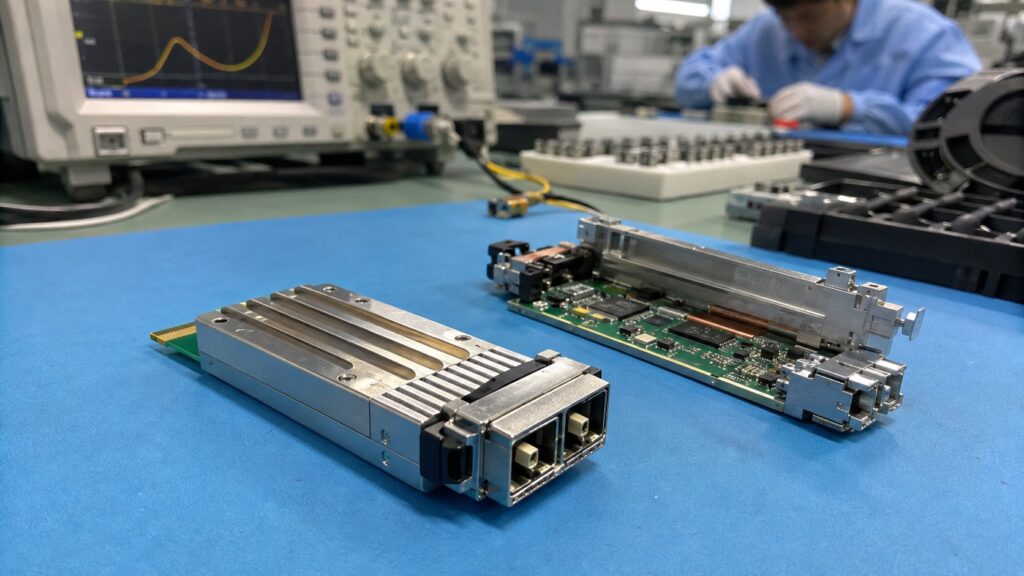
Citi said in an Aug. 9 research note that the reported U.S. move to block Chinese optical modules from the American market has not yet become an effective ban under existing Federal Communications Commission rules. Reviewing FCC Order 26-50, the bank said optical modules do not appear on any active restricted list. They are mentioned only once in an example tied to hardware and software bill-of-materials disclosure, not in the ban section. The bank outlined three possible regulatory routes: restrictions tied to specific manufacturers, restrictions based on all foreign production locations, and a narrower origin-based approach aimed only at products made in China. Citi judged the manufacturer-based route the least likely and said origin-based restrictions are more plausible, though near-term enforcement remains unlikely. Its main argument is supply. Citi estimated Chinese suppliers account for 60% to 70% of high-speed optical modules used by U.S. hyperscalers. Non-Chinese suppliers, in its view, cannot close that gap in the short run, while domestic U.S. production lines still need time to ramp. The report also singled out Eoptolink and DSBJ as the most exposed among the companies discussed, while Tianfu Communication was described as relatively insulated because it supplies passive components that do not fall within the current restricted-list framework.

1310
Citi says proposed U.S. curbs on Chinese optical modules have not advanced beyond the idea stage
Shenzhen
2026-08-10 05:18:11

Shenzhen IPO wave delivers gains to state-backed investors across Chinese cities

Shenzhen is emerging as a major source of IPO-driven returns for state-backed investors across China, according to the article republished by MarsBit from the WeChat account Zhengjieju. The piece says Shenzhen has added 26 domestic and overseas listed companies so far this year, the highest total among large and mid-sized Chinese cities, and argues that many of those listings have created sizable paper gains for government capital and industry funds from outside the city. The article highlights several cases. AI storage chip company Dapu Micro listed on ChiNext on April 16 at RMB 46.08 per share and now has a market value above RMB 200 billion. Shenzhen’s Longgang district guidance fund, which invested RMB 20 million in 2019, still held 5.6991 million shares at the time of listing, with a market value above RMB 2 billion. Nanjing Qilin Venture Capital, which invested RMB 80 million in 2020 for a 5.18% stake, is described as the company’s largest state-owned shareholder. It also points to HKC Corp., listed on the Shenzhen Stock Exchange main board on June 26, where state-backed investors from Mianyang, Liuyang in Changsha, Chongqing, Gui’an and Chuzhou recorded gains after earlier strategic investments. The article frames this as a model of regional coordination: Shenzhen incubates technology companies, outside cities invest through equity, and manufacturing capacity is then deployed in multiple locations.

1130
Shenzhen IPO wave delivers gains to state-backed investors across Chinese cities
Trump
2026-08-04 11:34:50

FCC said to target Chinese optical transceivers, lifting AAOI and other photonics stocks in premarket trade

Reuters, citing people familiar with the matter, reported that the Trump administration is drafting restrictions on imports of new Chinese-made data center components, with the U.S. Federal Communications Commission planning limits on Chinese optical transceivers and aiming to announce and put the measure into effect this year. The White House and the FCC did not comment on the report. The news sent U.S. optical networking and photonics names sharply higher in premarket trading. As of 6:47 p.m. Taipei time, Applied Optoelectronics rose 18.17% to $130.23, Coherent gained 14.23% to $329.15, and Lumentum advanced 11.33% to $868.27. Marvell, FOTO, Corning, Ciena, and Credo also posted sizable gains, while Nvidia was up 1.02% over the same period. The report also pointed to China’s position in high-speed optical modules. Innolight was described as holding more than 40% of the global 800G market and 50% to 70% of the 1.6T market, while Eoptolink was estimated at 25% to 30% in 800G. Together, the two companies account for roughly two-thirds of supply in the current mainstream 800G segment, according to the article.

2390
FCC said to target Chinese optical transceivers, lifting AAOI and other photonics stocks in premarket trade
South Korea c
2026-07-22 02:02:40

Why Korean Exchanges See Outsized Listing Pops: 85% of Trading Flows to Altcoins

South Korea’s crypto market runs on a structure that looks almost inverted relative to major global venues. In the period cited in the source article, Bitcoin accounted for just 9% of trading in Korea, while 85% of volume went to altcoins and newly listed tokens. Upbit and Bithumb, the country’s two dominant exchanges, together controlled nearly 96% of trading, with a retail-heavy user base driving much of the activity. The article argues that four structural constraints help explain the pattern: no legal domestic crypto derivatives, capital controls that keep out overseas market makers and arbitrage desks, a narrower listing universe, and a market culture shaped largely by retail traders rather than institutions. That setup has produced a distinct “KRW listing premium.” Newly added tokens on Upbit and Bithumb have repeatedly posted sharp moves in both price and volume, while Korea’s closed fiat rails and local order flow have made those moves harder to arbitrage away. Still, the effect fades over time. The source says most tokens lose the bulk of their liquidity within 10 to 15 weeks of listing, and only a minority retain more than 10% of peak trading activity after 51 weeks. The result is a market where listing-day enthusiasm can be intense, but long-term liquidity is far more selective.

320
Why Korean Exchanges See Outsized Listing Pops: 85% of Trading Flows to Altcoins