Backclaims

claims

Hyperliquid
2026-08-20 10:07:55

HYPE jumps 26.86% as traders price in faster U.S. compliance progress for Hyperliquid

HYPE surged 26.86% in 24 hours to $73.9, leaving it less than $3 below its recent high near $76.5, as attention shifted to Hyperliquid’s prospects in the United States. In its analysis, Odaily said the move was not driven by price action alone. It linked the rally to a White House crypto meeting where Donald Trump said the chair of the U.S. Commodity Futures Trading Commission, or CFTC, is working to bring Hyperliquid into the U.S. in a fully compliant and legal way. That comment came on top of earlier signals from Hyperliquid’s policy push, including a joint SEC submission by the Hyperliquid Policy Center and trade.xyz proposing a framework for pre-IPO perpetual products known as IPOP. Odaily also reviewed several milestones around that lobbying effort, from trade.xyz’s five IPOP markets on Hyperliquid to meetings with the SEC crypto task force and prior regulatory discussions tied to IPO reform. The report further highlighted CFTC chair Michael Selig’s public remarks on regulatory clarity and his role in derivatives approvals involving platforms such as Kalshi and Coinbase. The article then outlined three possible routes for Hyperliquid to enter the U.S. market in a compliant form: partnering with licensed clearing or execution venues, listing Hyperliquid-related assets through regulated platforms, or acquiring or rebuilding a U.S.-compliant venue from scratch. Odaily said the process could still take several months to more than a year.


70
HYPE jumps 26.86% as traders price in faster U.S. compliance progress for Hyperliquid
AI bubble
2026-08-20 08:02:00

AI and semiconductor boom may be nearing its end, guest on PANews show warns of a potentially harsh 2027

A guest on PANews’ 168X program said he has stayed mostly in cash since cutting positions in May and June, arguing that several AI and semiconductor trades are no longer attractive at current levels. Speaking on Aug. 19, the guest, identified as "QihongF44102" and referred to in the show as an industry insider active in both AI development and markets, said Korea, Japan and A-share names tied to the theme have likely already topped out. He also argued that, outside Coding, the market still lacks a second large AI use case that can scale quickly enough to support current expectations. The discussion centered on rising pressure across the AI value chain. The guest said top AI labs face a short-term bubble risk, open-source models are advancing fast, and downstream monetization remains the key variable for whether extreme upstream margins can hold. He pointed to 86% gross margin at SK Hynix and questioned whether such levels are sustainable if application-layer profitability weakens. He also described the current cycle as closer to a real-estate-style financing structure than a replay of the 2000 bubble, with leverage, data-center buildout and expectations for sustained high growth all tightly linked. The program also touched on robotics, Neoclouds, memory names, IPO timing and crypto. The guest said humanoid robotics is unlikely to see mass adoption within five years, called leverage-heavy AI infrastructure plays the most fragile part of the trade, and said retail investors may be better off waiting in cash or buying put protection if they already hold chip exposure. His most bearish call: if no new application breakthrough appears, 2027 could be a year of large index declines.

110
AI and semiconductor boom may be nearing its end, guest on PANews show warns of a potentially harsh 2027
Bitcoin
2026-08-20 10:33:57

Old Vance Video Revives Debate Over Bitcoin and the Dollar’s Reserve-Currency Burden

A resurfaced video featuring U.S. Vice President J.D. Vance has renewed debate over a question that rarely gets a direct airing in Washington: does the dollar’s role as the world’s reserve currency benefit the United States without meaningful trade-offs? In a piece cited by TechFlowPost and written by Forbes contributor Dave Birnbaum, the argument is that reserve-currency status lowers the cost of imports for Americans but also weakens U.S. manufacturing and export competitiveness by supporting a strong dollar. The article places that tension inside the long-running Triffin dilemma, first set out more than 60 years ago, which holds that a national currency cannot indefinitely serve both domestic policy needs and global reserve demand without conflict. It revisits the Bretton Woods system, the 1971 break with gold, and the way global dollar demand is now channeled through U.S. Treasuries, with foreign investors holding about $9.3 trillion. The piece also says stablecoins backed by Treasuries expand the reach of the dollar but do not solve the underlying contradiction. Gold points toward politically neutral reserve assets, it argues, but Bitcoin may offer a different model by combining neutrality, fixed issuance and easier cross-border settlement, even as volatility and market maturity remain obstacles for central-bank adoption.

50
Old Vance Video Revives Debate Over Bitcoin and the Dollar’s Reserve-Currency Burden
crypto stocks
2026-08-20 04:51:13

How Major CEXs Are Building Crypto Stock Products Across Brokerage, Tokenized Equities and Perpetuals

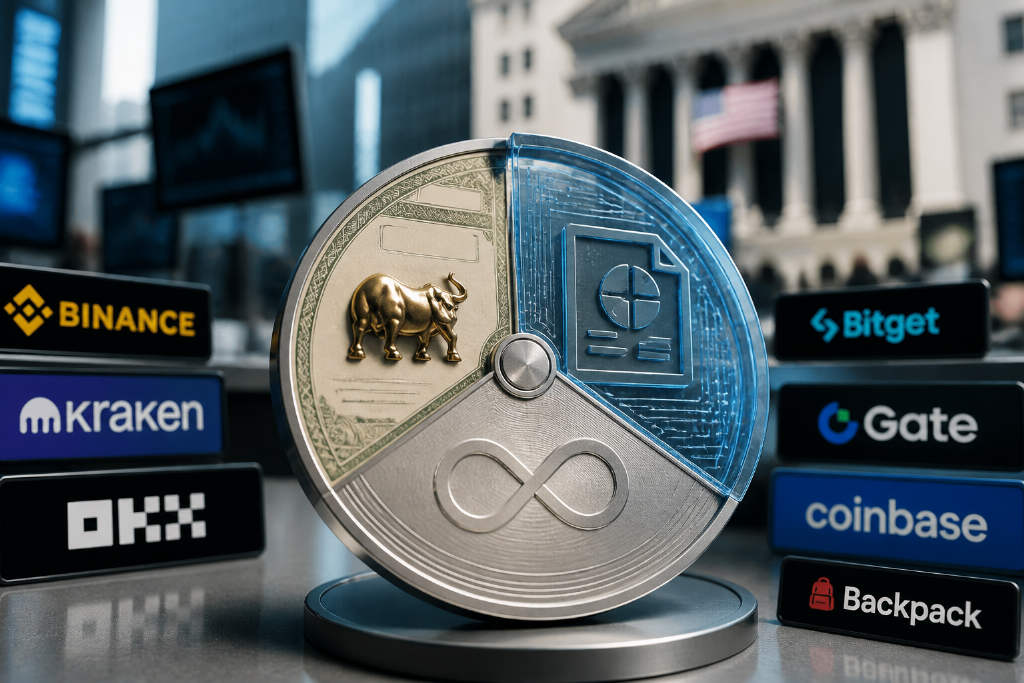
Crypto exchanges are pushing deeper into equities, turning stocks into one of the clearest product expansion paths in this market cycle. CoinGecko data cited in the report shows monthly stock perpetual volume across the top 13 crypto trading platforms climbed from about $831 million in July 2025 to roughly $34 billion in May 2026, a jump of nearly 40 times in less than a year. TradFi and RWA perpetuals spanning stocks, commodities and indexes reached $347.17 billion in May 2026 alone, with year-to-date volume above $1.32 trillion. The landscape is no longer limited to synthetic price exposure. Binance, Kraken, OKX, Bitget, Gate, Coinbase and Backpack are each combining different layers of product infrastructure, including direct access to real U.S. stocks and ETFs, tokenized stocks backed 1:1 by underlying securities, onchain-transferable equity tokens, stock perpetuals, CFDs and pre-IPO contracts. Their structures differ in important ways, especially around custody, investor rights, redemption and whether users actually own shares or only gain economic exposure. The report argues that crypto stocks remain early relative to traditional equity markets, with CoinGecko data indicating activity in crypto stock derivatives is still less than 1% of traditional stock market volume. Even so, the segment is moving from a niche RWA experiment toward a core competitive arena for centralized exchanges that want to extend from crypto into broader financial trading.

140
How Major CEXs Are Building Crypto Stock Products Across Brokerage, Tokenized Equities and Perpetuals
Meta
2026-08-20 08:32:50

Meta’s $1.4 trillion case is weighing on the stock, but the bigger trade may be valuation rather than a verdict-day options bet

Meta Platforms is being tried in a California-led consumer protection case that carries an extraordinary penalty range: states have asked for as much as $1.4 trillion, while Meta has countered with $4 million. The gap, as framed in the source article by Balder and translated by TechFlow, spans five orders of magnitude and leaves investors facing unusual uncertainty during the trial itself. Since the last close before jury selection, META has fallen 8.4%, versus a 0.7% decline in the S&P 500, a move the author argues reflects company-specific pressure rather than a broader market selloff. The article’s core argument is that the obvious trade — buying verdict-day, same-day-expiry call options — may be the wrong one. Because the ruling date is undisclosed, the risk lies not only in being wrong on direction but in being wrong on timing, while implied volatility on binary legal events is already expensive. Instead, the author says investors may be overlooking a different setup: Meta trades at about 16.9x forward earnings even as current profits are being depressed by heavy AI infrastructure and model spending. In that framing, the stock’s multiple and the durability of its advertising system may be more mispriced than any one-day options lottery tied to the court’s final filing.

30
Meta’s $1.4 trillion case is weighing on the stock, but the bigger trade may be valuation rather than a verdict-day options bet
Evergrande
2026-08-20 06:54:00

Evergrande founder Xu Jiayin gets life sentence as court orders full asset confiscation

A court in Shenzhen sentenced China Evergrande Group founder Xu Jiayin to life imprisonment on Aug. 20 after finding him guilty on multiple charges including financial fraud, illegal fundraising and bribery, according to BlockTempo. The court also stripped him of political rights for life and ordered the confiscation of all personal assets under his name. The ruling extends beyond Xu himself. Evergrande Group and Evergrande Real Estate were fined a combined 15.82 billion yuan, with 8.82 billion yuan imposed on the parent group and 7 billion yuan on the property unit. Illegal gains are still being pursued, and any shortfall is to be repaid. The report said the court found Xu had used his position to orchestrate falsified financial statements, hide liabilities, inflate assets and divert company property under the name of dividend distributions between 2016 and 2021. The case is being treated as a major legal endpoint in a crisis that has dragged on for nearly five years. BlockTempo also said 56 other Evergrande-linked individuals, including Zhen Litao and Ke Peng, were sentenced the same day in Nanshan District, with prison terms ranging from 1 year and 10 months to 18 years. The ruling may also complicate recovery efforts for domestic and offshore creditors because criminal confiscation now overlaps with ongoing liquidation and civil claims.

60
Evergrande founder Xu Jiayin gets life sentence as court orders full asset confiscation
Pharos
2026-08-20 06:30:35

Pharos’ 14.3% RWA vault draws $45.39 million and a debate over liquidity

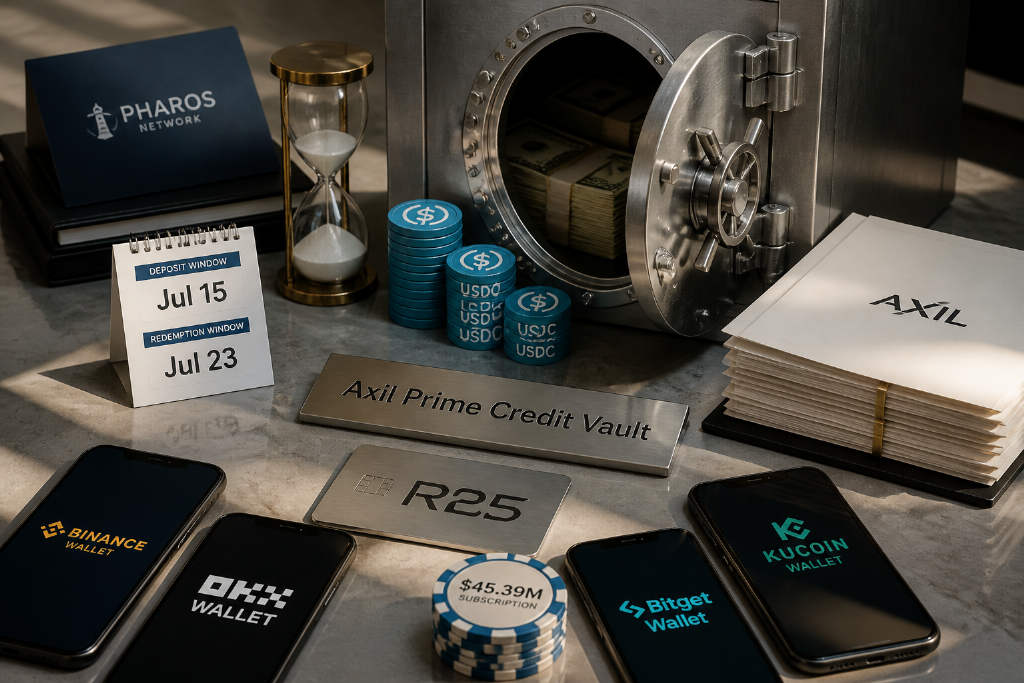
Pharos Network’s Axil Prime Credit Vault, launched with R25 and Axil on July 15, pulled in $45.39 million before its pre-deposit window closed, against a $100 million USDC cap and a target annualized yield of about 14.3%. The product went live across Binance Wallet, TopNod, OKX Wallet, Bitget Wallet and KuCoin Wallet, with Binance Wallet adding $300,000 in PROS incentives. But the launch also collided with the redemption window for an earlier Pharos TGE pre-deposit vault, prompting complaints from users who were used to DeFi-style instant exits and said they had missed the withdrawal deadline. On July 23, Pharos said users who had submitted redemption requests on time had received full principal and interest, while funds that missed the window were automatically rolled into the next three-month cycle and continued earning 14% APY in USDC under the preset rules. The episode has become a case study in a broader RWA tension: low entry thresholds can bring retail users in, but that does not make the underlying assets liquid. In APC’s case, the yield is tied to emerging-market consumer credit rather than mostly token emissions, while the trade-off is a longer lockup and a redemption process shaped by offchain credit assets, licensed fund managers and traditional finance settlement timelines.

80
Pharos’ 14.3% RWA vault draws $45.39 million and a debate over liquidity
AI agents
2026-08-20 04:38:50

Industry executives warn AI agents could turn crypto hacks into cheap, recurring attacks

Crypto industry executives warned in a discussion on AI and blockchain security that the rise of AI agents could change the shape of crypto attacks. Instead of the occasional billion-dollar exploit, the sector may face a cheaper and more routine stream of small thefts if autonomous systems begin handling both attack and defense. According to a report cited by The Block, the issue is not raw AI compute power alone. The bigger problem is that trust and accountability boundaries are still unsettled. Speakers said AI agents could reduce friction across decentralized systems, including cross-chain matching, yield loops and autonomous onchain execution. At the same time, they introduce new risks around key management, permission boundaries and privacy. They also pointed to three unresolved hurdles that must be addressed before AI agents can be used in day-to-day crypto operations: trust, hallucinations and legal liability. The discussion also highlighted two areas to watch next: whether smart contracts and DeFi infrastructure build in agent verification and human checkpoints, and whether regulators move early to define how responsibility for AI agent actions fits inside existing digital asset rules. In markets including Taiwan, where stablecoin and digital asset frameworks are still being developed, clearer liability lines for AI agents could improve market acceptance.

80
Industry executives warn AI agents could turn crypto hacks into cheap, recurring attacks