‹ Backrisk on

risk on

RWA
2026-08-24 01:00:00

Tokenization Alone Does Not Make RWAs Useful, Sentora Co-Founder Says

Sentora co-founder Jesus Rodriguez argues that tokenizing real-world assets is only the starting point, not the breakthrough many in the sector describe. In his view, putting Treasury bills, fund shares, stocks, invoices, megawatt-hours, or GPU compute hours onchain creates an addressable claim, but not a functioning market by itself. The real test is whether those assets can be valued, financed, hedged, liquidated, and loss-allocated inside DeFi without requiring repeated offline coordination. Rodriguez says the weak point in many RWA designs is not representation but market structure. He points to mismatched settlement clocks between blockchains, oracles, custodians, traditional exchanges, and redemption processes, arguing that this timing gap can turn even low-volatility assets into difficult collateral. He also challenges common assumptions around liquidity, saying total value locked or issuer redemption promises do not equal real exit capacity under stress. The article extends that framework to tokenized Treasuries, GPU and energy-linked assets, and tokenized equities paired with perpetual futures. Across those segments, the core claim is consistent: RWA utility comes from the DeFi market layer built around the token, while leverage, liquidation design, oracle freshness, custody dependencies, and weekend risk define whether the structure can actually hold under pressure.
1120
Tokenization Alone Does Not Make RWAs Useful, Sentora Co-Founder Says
AI compute
2026-08-21 06:14:55

Open-Source Models Are Pushing AI Compute Toward Capital Markets

Foresight says the capital structure behind AI infrastructure is changing fast. The AI-related capex of the top five cloud providers rose from 20%–30% of operating cash flow in 2020–2023 to nearly 94% in 2025, with confirmed 2026 capex already above $700 billion. The article argues that take-or-pay contracts, GPU lending, and rising public-market demand from open-source models are pushing compute toward pricing benchmarks, forwards, and derivatives. It also notes that after DeepSeek V4 launched, H100 rental rates rose about 7.5% within two weeks, while similar strength appeared around the launches of Kimi K3 and GLM 5.2. The larger point is that compute only becomes financialized once enough of it is traded openly, priced repeatedly, and separated from the balance sheets that used to absorb the risk.

1150
Open-Source Models Are Pushing AI Compute Toward Capital Markets
SEC
2026-08-20 08:49:07

SEC proposal would open a legal token issuance path in the U.S. by centering disclosure, not merit review

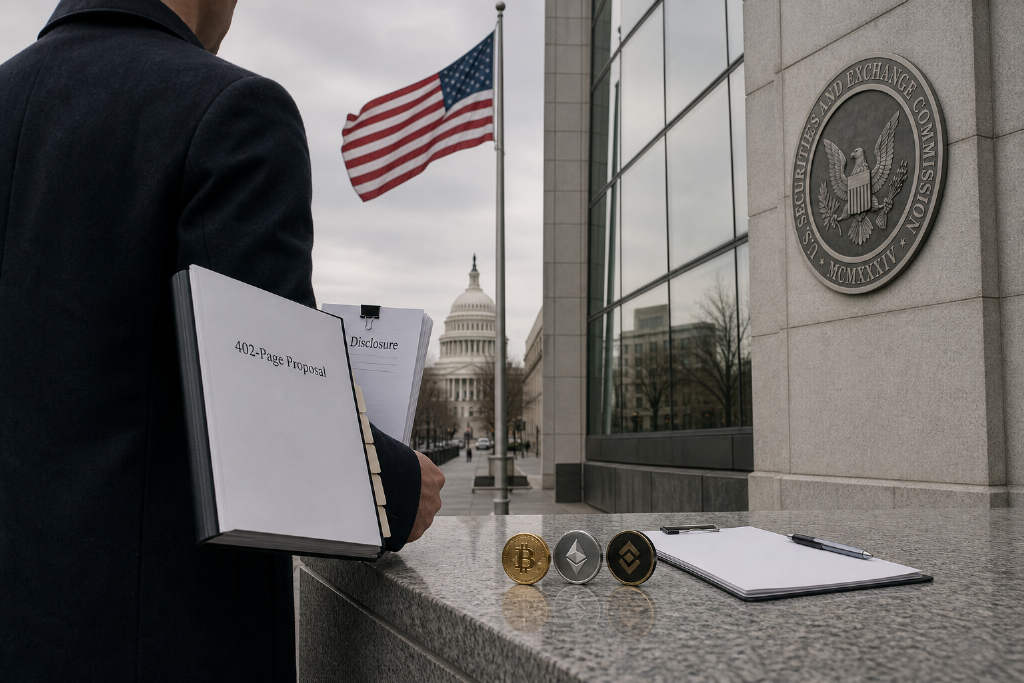
The U.S. Securities and Exchange Commission has released a 402-page crypto asset regulation proposal that would create two exemptions for new crypto projects to issue tokens to users and investors without violating securities laws, according to the article. The proposal keeps anti-fraud rules in place and bars "bad actors" from participating, while requiring issuers relying on either exemption to provide principle-based narrative disclosures. The piece argues that the framework marks a return to the SEC’s original disclosure-first mandate: regulators should make sure investors receive the facts they need, then let them decide for themselves rather than passing judgment on the quality of the investment. It places the proposal in the historical context of Franklin D. Roosevelt’s 1933 message to Congress, Louis Brandeis’s view that disclosure works as a market disinfectant, and former SEC Chair Joseph Kennedy’s explanation that the agency was not created to approve securities. The article also points to Blockworks’ Token Transparency Framework, launched in June 2025, where 75 protocols have filed standardized disclosures and 69 exchanges, custodians and asset managers have joined an alliance that uses those filings in due diligence.

1010
SEC proposal would open a legal token issuance path in the U.S. by centering disclosure, not merit review
AI
2026-08-14 10:40:06

AI Spending Fuels Bond Rush Among U.S. Tech Giants, With Nearly $2 Trillion in Off-Balance-Sheet Commitments

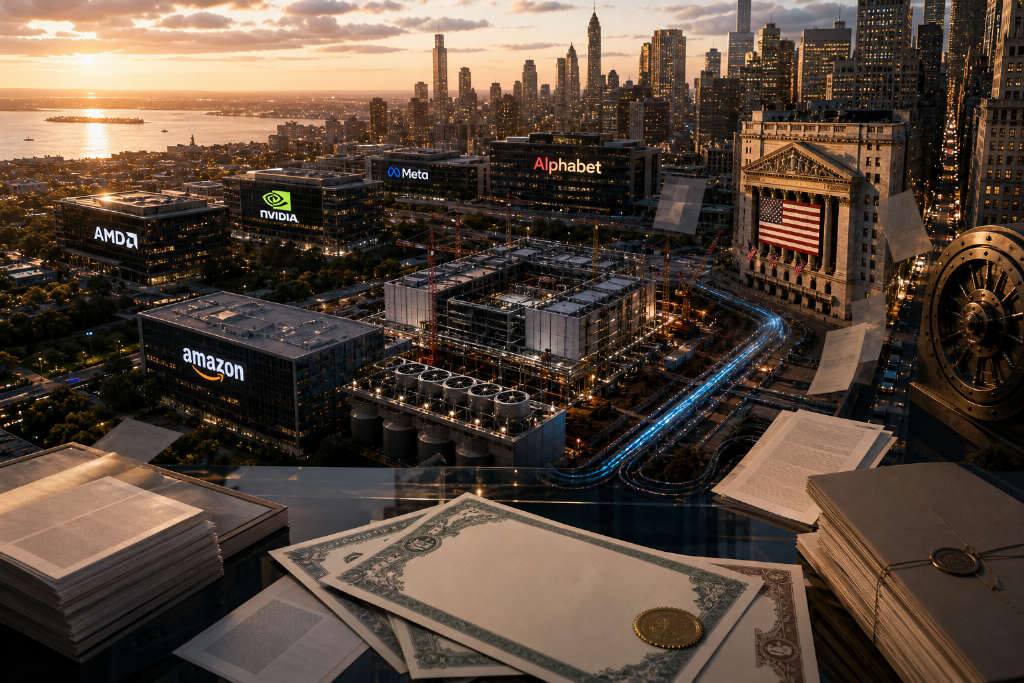
A debt wave tied to artificial intelligence spending is sweeping through major U.S. technology companies, with AMD’s $4.75 billion bond sale adding to a year of outsized fundraising across the sector. Bloomberg reported on Aug. 13 that the chipmaker completed the largest U.S. dollar bond offering in its history. Earlier this year, Nvidia sold $25 billion in bonds and drew roughly $85 billion in orders, while Alphabet also raised $25 billion in early August with demand reaching $115 billion. Reuters, citing London Stock Exchange Group data on Aug. 14, said Alphabet, Amazon and Meta had issued nearly $220 billion in bonds so far this year, more than double the $108 billion sold during all of 2025. The visible borrowing is only part of the picture. An Aug. 11 article from BigGoFinance, citing recent research from Goldman Sachs and Morgan Stanley, said AI cloud companies including Alphabet, Microsoft, Amazon and Meta have amassed close to $2 trillion in off-balance-sheet financial commitments through leases that have not yet started and procurement contracts. Goldman estimated about $1.5 trillion in off-balance-sheet lease commitments, including around $1 trillion not yet commenced. Morgan Stanley put procurement commitments for Alphabet, Microsoft, Amazon, Nvidia and Oracle at $982 billion as of the end of the first quarter. Credit markets have begun to react, with Beignet bonds yielding 6.95%, up from about 5.65% at issuance last autumn, while CDS pricing on debt from Oracle, Nvidia, Meta and Alphabet has also climbed to record highs.

1220
AI Spending Fuels Bond Rush Among U.S. Tech Giants, With Nearly $2 Trillion in Off-Balance-Sheet Commitments
NVIDIA
2026-08-13 08:03:25

Jensen Huang’s $500 Billion GPU Financing Push Raises Questions About AI Demand and Structured Risk

NVIDIA CEO Jensen Huang said he has lined up more than $500 billion in funding from Apollo, BlackRock, Blackstone, Brookfield, Goldman Sachs, and KKR to help NVIDIA customers keep buying GPUs. The pitch rests on a simple idea: GPUs can be treated as financeable assets because they generate revenue, serve a broad customer base, and have depreciation lives that can stretch beyond 10 years. That framing has invited comparisons to the pre-2008 era, when Wall Street bundled hard-to-value assets, borrowed against them, sliced the debt into tranches, and sold the risk onward. The source article argues the resemblance is real at the structural level, but it stops short of saying the outcome must be the same. Its case for caution is matched by a case for demand. GPU rental prices have risen about 40% since October, next year’s supply of the latest chips is already sold out, and large AI and cloud companies are still posting strong revenue numbers. The article says lenders are not handing over capital blindly either: borrowers must show repayment capacity and demonstrate that the GPUs can actually produce income, while Huang is offering guarantees of up to 25%. The core question, it says, is whether AI chips hold value and keep generating cash over time.

320
Jensen Huang’s $500 Billion GPU Financing Push Raises Questions About AI Demand and Structured Risk
Whale Trades
2026-08-12 09:46:18

Whale’s $2.675 million S&P short nears liquidation while Polymarket hedge stays tiny

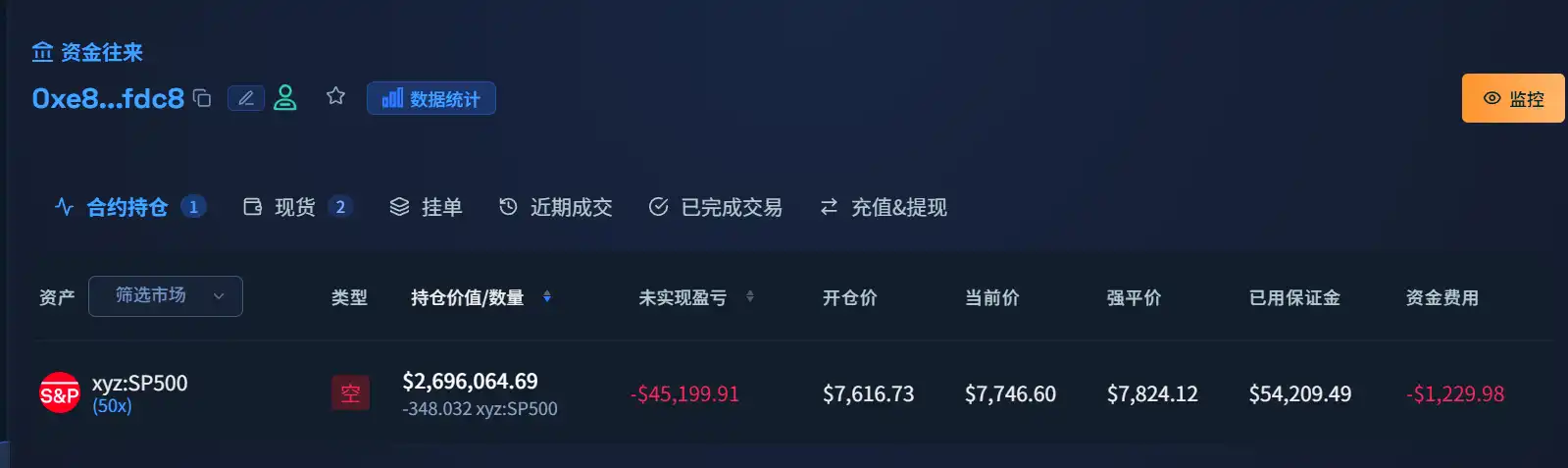
A trader identified by TradingBeats, formerly Hyperinsight, is running a split macro bet ahead of the U.S. CPI release: rate-cut positions on Polymarket and a heavily leveraged short on the S&P 500 through Hyperliquid. The setup appears to leave room for different CPI outcomes, but the size mismatch is stark. On Polymarket, the trader known as "fafafa..." has kept buying rate-cut related shares since mid-June and still holds seven unresolved positions tied to scenarios including September and October cuts, as well as one to two total cuts this year. Those positions have a cumulative cost of about $1,545.9 and are currently worth roughly $670, leaving an unrealized loss near $875.9. Four earlier settled rate bets also ended in losses. The larger exposure sits on Hyperliquid under address 0xe8e, where the trader’s only open position is a 50x isolated short of 345.4 SP500 contracts valued at about $2.675 million. The entry was 7,615.7, the floating loss stood near $45,300, and the reported return was about -86%. Liquidation is at 7,824.1, around 77 points, or roughly 1%, from the current price. The stop-loss was set at 7,823, just 1.1 points below liquidation.

1570
Whale’s $2.675 million S&P short nears liquidation while Polymarket hedge stays tiny
Whale Movemen
2026-08-12 10:49:01

S&P 500 Liquidation Risk Clusters at 7,420-7,430; Upside Shorts at 1.6x Downside

Data from TradingBeats (formerly Hyperinsight) shows the S&P 500's near-term liquidation risk is concentrated in the 7,420 to 7,430 range ahead of the U.S. CPI release, roughly 4.1% below the index's current level of 7,744.6 points. That zone holds potential liquidation positions tied to 18 long addresses, with the most prominent being a whale address starting with 0x7c93 that carries about $25.041 million in SP500 longs at 50x full margin and a liquidation price of 7,427.3 points. Measured within a 5% band above and below the current price, potential short liquidations above total approximately $74.334 million, compared with roughly $46.185 million in long liquidations below — meaning the former is about 1.6 times the latter. Should the CPI print push the index upward, the pool of shorts waiting to be squeezed above could be even larger. By comparison, XYZ100 has only about $11.96 million in potential short liquidations within 5% above its current price, a far lighter near-term liquidation load than the S&P 500.

1500
S&P 500 Liquidation Risk Clusters at 7,420-7,430; Upside Shorts at 1.6x Downside
U.S. stocks
2026-08-11 03:02:58

Real Stocks, tokenized shares or stock futures: MEXC outlines three ways to access U.S. equities

MEXC has launched a fee-free campaign for three U.S. equity-linked products during its August 2026 “U.S. Stocks Season”: RealStocks, Tokenized Stocks and Stock Futures. The exchange says the products all provide exposure to U.S. equities, but they differ sharply in legal ownership, shareholder rights, trading hours, leverage and use cases. RealStocks are spot U.S. stocks offered through a regulated broker setup and allow users to hold actual shares. Tokenized Stocks are blockchain-based instruments that track listed equities and trade around the clock, but they do not necessarily grant direct legal ownership of the underlying stock. Stock Futures are perpetual contracts tied to stock or stock index prices, designed for directional trading with leverage of up to 200x. MEXC said the comparison is meant to help users match product structure with investment goals, whether that means long-term ownership, flexible on-chain access or leveraged short-term trading. The platform also disclosed that more than 120,000 users opened RealStocks accounts in its first month, while stock and index futures volume rose about 261% month over month in June 2026.

1760
Real Stocks, tokenized shares or stock futures: MEXC outlines three ways to access U.S. equities