Box

Oil Prices
2026-09-15 02:55:24

Brent climbs to $107 as Houthi attacks on Saudi Arabia and Gulf shipping tensions lift oil prices

International oil prices moved higher on Tuesday as markets reacted to a fresh round of attacks on Saudi Arabia by Yemen’s Houthi forces and to Iranian actions involving vessels in the Persian Gulf. According to CNBC, November Brent crude futures rose 1.25% to $107.00 a barrel, while October West Texas Intermediate crude futures gained 1.27% to $102.68 a barrel. Pressure on supply routes remained a central focus. On the western side of the Arabian Peninsula, a Saudi-led coalition said Houthi forces launched ballistic missile and drone attacks on Saudi territory on Monday, injuring 13 civilians, according to Al Jazeera. On the eastern side, Saudi Arabia had already shut its East-West pipeline after damage caused by a drone from Iraq, removing a key route used to bypass the Strait of Hormuz. Separately, U.S. Central Command rejected a claim by Iran’s Islamic Revolutionary Guard Corps that the Panama-flagged tanker El Gaia struck a mine in the strait, saying instead that the vessel lost power last month after being hit by an Iranian missile. Komal Sri-Kumar of Sri-Kumar Global Strategies said pipeline disruptions and an escalating tariff war would add to inflation pressure.

550
Brent climbs to $107 as Houthi attacks on Saudi Arabia and Gulf shipping tensions lift oil prices
Federal Reser
2026-09-15 01:59:16

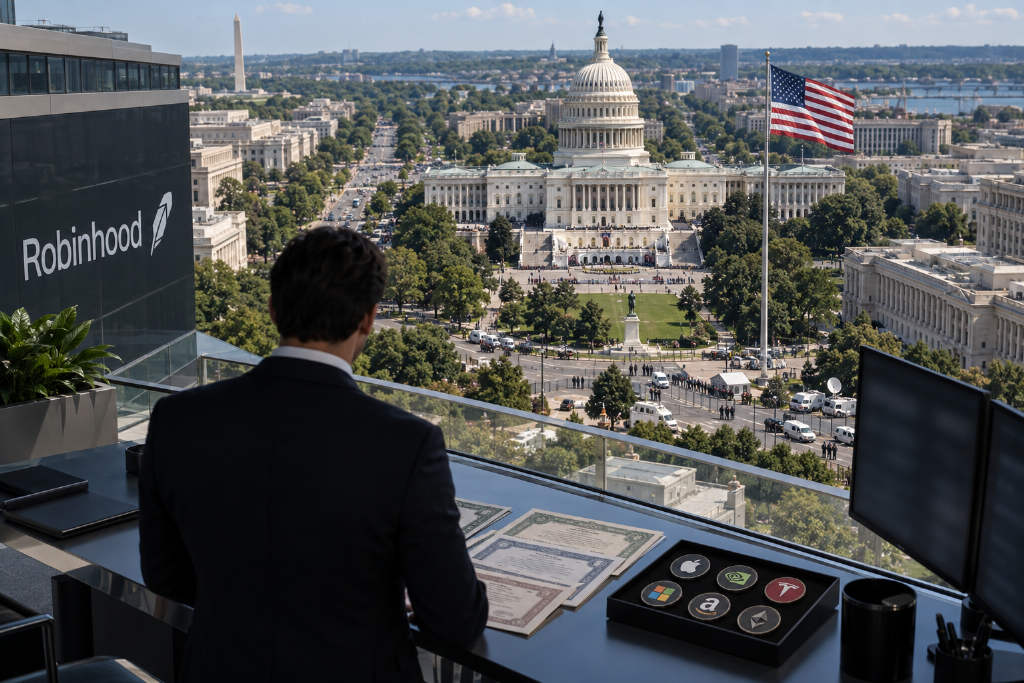
Fed decision, CLARITY vote and tokenized stocks take center stage as Robinhood CEO rejects issuer veto

Global markets are heading into a packed week that could shape both macro sentiment and crypto policy. The U.S. Federal Reserve is set to release its rate decision and economic projections early Thursday Beijing time, followed by remarks from Chair Warsh, while the Bank of England and the Bank of Japan are also due to announce policy decisions later in the week. In Washington, the U.S. Senate is preparing for a key procedural vote on the CLARITY Act on Tuesday, the same day the Securities and Exchange Commission plans to hold a roundtable on 24-hour trading. Around that backdrop, market participants are weighing fresh comments from Robinhood CEO Vlad Tenev, who argued that issuers should not have veto power over tokenized stock products if those instruments do not alter shareholder rights, issuer obligations, or the company’s official share register. Other developments include the EU’s Cyber Resilience Act taking effect, new product launches from Kraken and Grayscale, financing updates from Kaiko, Temporal and tZERO, continued inflows into spot Ether ETFs, and a newly disclosed exploit affecting Symbiosis’ Bitcoin bridge.

970
Fed decision, CLARITY vote and tokenized stocks take center stage as Robinhood CEO rejects issuer veto
Kaiko
2026-09-15 02:15:09

S&P Global Backs Kaiko as Wall Street Deepens Its Push Into On-Chain Market Data

Crypto market data provider Kaiko said on Sept. 14 that it had secured an extension of its Series B round, bringing total funding to $110 million, with S&P Global leading the deal through S&P Global Ventures. The round also drew a mix of traditional finance and crypto investors, including BNP Paribas, Bpifrance, Broadridge, Canton Foundation, Coinbase Ventures, DRW Venture Capital, Nasdaq Ventures, RBC, Stellar and Susquehanna Private Equity Investments, while existing backers Anthemis, Point Nine and Revaia also joined. The financing came alongside a broader strategic push. Kaiko said it will chair a Strategic Industry Working Group with all strategic investors participating, aimed at setting data standards and infrastructure rules for tokenized markets. The investment follows a series of recent ties between Kaiko and S&P entities, including the on-chain launch of the iBoxx U.S. Treasuries Index on Canton Network on March 31 and the Sept. 1 release of the co-branded S&P Kaiko Digital Asset Indices, which cover more than 4,000 rates and indices. The deal lands after Kaiko spent years building out institutional products, compliance credentials and acquisition capacity. The company said it now covers more than 150 exchanges and protocols and serves more than 250 financial institutions and regulators.

720
S&P Global Backs Kaiko as Wall Street Deepens Its Push Into On-Chain Market Data
European Unio
2026-09-14 11:38:44

EU cyber rules give crypto wallet makers 24 hours to report exploited flaws

Cryptocurrency wallet providers in the European Union now face a tight disclosure schedule under the bloc’s Cyber Resilience Act. The new rules require hardware and software wallet makers to file an early warning within 24 hours after becoming aware of an actively exploited bug or severe vulnerability affecting their products, then submit a full notification within 72 hours. A final report must follow 14 days after corrective or mitigating measures become available, while severe incidents must be fully reported within one month. The reporting regime applies to products with digital elements made available in the EU, not only crypto wallets, and sits within the European Commission’s broader cybersecurity strategy. Penalties are steep: companies that fail to comply with Articles 13 and 14 can face fines of up to 15 million euros, or 2.5% of worldwide annual turnover, whichever is higher. Supplying incorrect, incomplete or misleading information can trigger fines of up to 5 million euros. The move comes after recent security incidents involving wallet providers and related service vendors, including Trezor’s disclosure that 67,000 additional US customers were exposed in a breach tied to shipping provider ShipMonk, phishing warnings issued by Trezor and BitBox, and a June warning from Zilliqa about a flaw in the Zilliqa Ledger app that could expose private keys.

180
EU cyber rules give crypto wallet makers 24 hours to report exploited flaws
EU
2026-09-14 11:51:35

EU Cyber Resilience Act Takes Effect With Tight Breach Reporting Rules for Crypto Wallet Providers

The European Union’s Cyber Resilience Act, or CRA, officially took effect on Sept. 11, setting stricter incident-reporting obligations for providers of crypto hardware and software wallets sold in the EU market. Under the new rules, firms must file an early warning report within 24 hours after discovering an actively exploited vulnerability or a severe security flaw, then submit a full notification within 72 hours. After corrective or mitigation measures are taken, manufacturers must provide a final report within 14 days, while severe incidents must be fully reported within one month. The European Commission said the reporting framework is meant to better protect consumers and businesses from cyber threats. The rules apply to all products with digital elements offered on the EU market and form part of the bloc’s broader cybersecurity strategy. Penalties in the final draft are substantial: companies that fail to comply with Articles 13 and 14 may face administrative fines of up to €15 million, roughly $17.3 million, or 2.5% of global annual turnover, whichever is higher. Firms that submit incorrect, incomplete, or misleading information may be fined up to €5 million. The measure comes after several security incidents involving wallet providers. Trezor said on Sept. 4 that a data breach at logistics vendor ShipMonk affected about 67,000 U.S. customers, above the initial estimate of 14,000. This week, Trezor and BitBox also warned users about phishing emails disguised as urgent security notices. In June, Layer-1 blockchain network Zilliqa said a flaw in its Ledger app could allow attackers to recover private keys using public on-chain data.

670
EU Cyber Resilience Act Takes Effect With Tight Breach Reporting Rules for Crypto Wallet Providers
PANews
2026-09-12 01:30:00

PANews weekly roundup spotlights LAPTOP token plan, Robinhood chain frenzy and ZEC surge

PANews published a weekly selection of crypto stories spanning regulation, market structure, institutional moves and on-chain speculation. The list highlighted Hunter Biden’s planned Base-based meme token LAPTOP, which is slated for a Sept. 9 launch and will partly airdrop tokens to TRUMP investors. It also pointed to rising activity around the Robinhood Chain ecosystem, including a tools guide built around wallets, trading terminals and launchpads after the chain was described as generating $2.6 million a day. Market coverage centered on privacy coins, with Glassnode data showing the sector up 213% this year and ZEC surging 2,496% while Bitcoin remained down 36%. Other featured items included debate around the CLARITY Act in the U.S. Senate, the SEC’s approval of tokenized fund shares, Ethereum’s proposed EIP-8141 for stablecoin gas payments, the Liquid Network attack involving 4,000 BTC, and a string of short headline items on Tether, Robinhood, Circle, Bybit, ether.fi and others.

970
PANews weekly roundup spotlights LAPTOP token plan, Robinhood chain frenzy and ZEC surge
ECCV
2026-09-11 02:51:21

ECCV 2026 names best paper, while Fei-Fei Li co-authored work wins test-of-time honor

ECCV 2026 has announced its annual awards, including best paper, best paper nominees and test-of-time distinctions, after this year’s conference ran from Sept. 8 to 12 in Malmo, Sweden. According to the conference figures cited in the source article, ECCV received 10,473 valid submissions, accepted 2,834 papers for a 27.1% acceptance rate, and selected 163 oral presentations, equal to 1.6%. The best paper award went to Imperial College London’s “Heat Kernel Textures -- the Geodesic Gaussians That Do Not Splat,” which introduces HKTex, a mesh-surface texture representation that replaces UV maps with anisotropic heat kernels placed directly on the surface. Two papers were named best paper nominees: Meta Reality Labs Research’s LSRM on scaling context windows for object-centric 3D reconstruction, and Stony Brook University’s Poppy, a training-free framework that uses a single polarization capture at test time to refine surface normal estimation. ECCV also gave three test-of-time awards to “SSD: Single Shot MultiBox Detector,” “Perceptual Losses for Real-time Style Transfer and Super-resolution,” co-authored by Fei-Fei Li, and “Learning Without Forgetting.” The source article also notes that ECVA released information on its PhD Award and Young Researcher Award.

290
ECCV 2026 names best paper, while Fei-Fei Li co-authored work wins test-of-time honor
Bitcoin
2026-09-10 13:04:27

Coinbase CEO Brian Armstrong says $400,000 Bitcoin by 2030 remains a reasonable target

Coinbase CEO Brian Armstrong said Bitcoin reaching $400,000 by 2030 still looks like a reasonable target, even with BTC trading near $77,000. Speaking to CNBC's Squawk Box Asia on Thursday, Armstrong said he believes the latest Bitcoin cycle has already found its bottom after the market moved through roughly a year of decline. He also pointed to Bitcoin's familiar four-year cycle and said rallies often appear ahead of halving events, with the next halving due in about 18 months. In his view, the next one to two years should be favorable for Bitcoin. Armstrong also spoke positively about U.S. crypto regulation. He said the Senate is set to vote on the Clarity Act on September 15 and that, based on his conversations in Washington, the bill appears ready to win approval. He added that law enforcement groups, many banks, and crypto companies support it, while earlier Coinbase objections have been addressed. The unresolved issue involves ethics rules tied to the president's family crypto ventures. Even if the bill stalls, Armstrong said the SEC and CFTC are prepared to move ahead with rulemaking and innovation exemptions under existing authority, leaving him expecting regulatory clarity within a month. He also said passage of the bill would open the door to tokenized equities and perpetual futures for U.S. customers.

730
Coinbase CEO Brian Armstrong says $400,000 Bitcoin by 2030 remains a reasonable target