GPT

Artificial In
2026-08-20 23:54:00

Tencent Research Institute article outlines five paradoxes of artificial intelligence

A commentary by Tencent Research Institute senior expert Yan Deli argues that artificial intelligence is advancing through a set of unresolved paradoxes rather than along a clean, linear path. The piece identifies five of them: forecasting, quantifying AI’s effect on jobs, the productivity puzzle, the mismatch between data’s strategic importance and its balance-sheet value, and the tendency to label each new wave of technology as the start of a new industrial revolution. The article revisits well-known AI forecasts from figures including Marvin Minsky, Geoffrey Hinton and Demis Hassabis, noting how predictions have repeatedly proved either premature or impossible to verify in real time. It also compares labor-market studies from institutions such as the OECD, IMF, World Economic Forum, World Bank, Goldman Sachs, McKinsey and Pew, saying their estimates vary so widely that they are hard to compare directly. Yan also points to weak productivity readings in the European Union after the launch of ChatGPT, contrasting them with stronger but still historically average U.S. figures, and argues that data remains difficult to price or monetize despite its central role in AI systems. The final section questions the repeated use of “the Fourth Industrial Revolution” to describe technologies ranging from microelectronics and the internet to blockchain, quantum computing and AI.
220
Tencent Research Institute article outlines five paradoxes of artificial intelligence
AI
2026-08-20 11:03:11

Terence Tao and Wang Hong say math needs to learn how to absorb AI-generated proofs

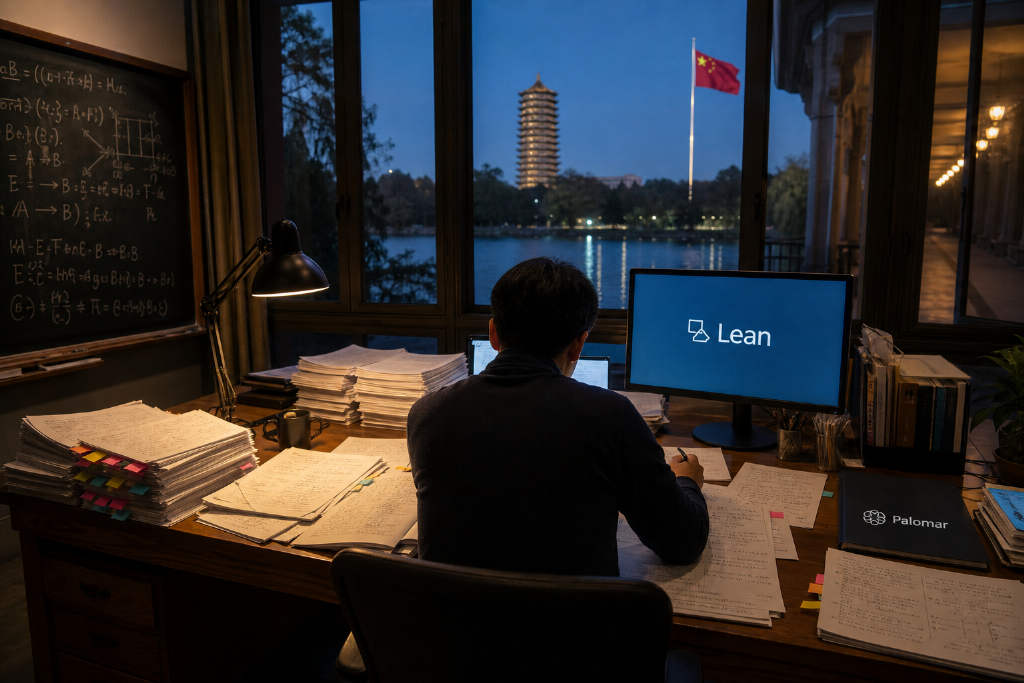
Artificial intelligence is producing mathematical proofs faster than the field can comfortably process, and that shift is forcing a debate over what counts as a complete mathematical result. In comments highlighted by MarsBit, Fields Medalists Terence Tao and Wang Hong arrive at much the same conclusion: mathematics cannot ignore AI-generated counterexamples or proofs, but it also cannot stop at machine output. Results still have to be understood, organized, explained, and absorbed by human researchers before they become fully usable. Tao’s recent work on the 67-year-old Sendov conjecture is presented as a concrete example. After math enthusiast Lech Mazur used AI to fill the long-open middle range of the problem and produced a Lean-verified formal proof, Tao spent several days reworking the result into a form mathematicians could actually read and use. According to the source text, that process not only clarified the proof but also extended it to the stronger Phelps–Rodriguez conjecture, while reducing the Lean code from about 90,000 lines to 15,000. Tao is also pushing a broader change in incentives. He argues that the field should place more value on digesting, explaining, reviewing, and integrating proofs, not just being first to announce them. He has also opened Palomar, a registry for Lean-verified results that records proof statements, code, AI involvement, and version details as a bridge between verification and formal publication.

150
Terence Tao and Wang Hong say math needs to learn how to absorb AI-generated proofs
Binance
2026-08-20 10:19:10

Binance launches Agent OS to connect AI apps with trading, wallet and payment rails

Binance has introduced Agent OS, a developer platform and standardized access layer designed to link AI applications with the company’s trading, market data, wallet, payment and on-chain capabilities across both crypto and traditional markets. The release combines several existing components inside the Binance stack, including Binance API, the Binance Wallet Agent Center, the programmable payments tool Binance x402, and Skill Hub, while also adding support for the Model Context Protocol, or MCP. Under the setup described by Binance, users can authorize agents through compatible tools such as ChatGPT, Claude Code, Codex and Cursor. Once authorized, those agents can access market data, view account information and carry out permission-limited trades. Binance said users can assign a separate sub-account to each agent so funds and trading activity stay isolated, and those permissions can be changed or revoked at any time. The company also said agents cannot access non-trading personal information such as email addresses or KYC data. Binance added that it will monitor and manage trading activity initiated through the platform, including resulting orders. At the same time, the sources, analysis and decision-making process used by an agent remain inside the AI application chosen by the user, which Binance said it cannot see.

140
Binance launches Agent OS to connect AI apps with trading, wallet and payment rails
AI bubble
2026-08-20 08:02:00

AI and semiconductor boom may be nearing its end, guest on PANews show warns of a potentially harsh 2027

A guest on PANews’ 168X program said he has stayed mostly in cash since cutting positions in May and June, arguing that several AI and semiconductor trades are no longer attractive at current levels. Speaking on Aug. 19, the guest, identified as "QihongF44102" and referred to in the show as an industry insider active in both AI development and markets, said Korea, Japan and A-share names tied to the theme have likely already topped out. He also argued that, outside Coding, the market still lacks a second large AI use case that can scale quickly enough to support current expectations. The discussion centered on rising pressure across the AI value chain. The guest said top AI labs face a short-term bubble risk, open-source models are advancing fast, and downstream monetization remains the key variable for whether extreme upstream margins can hold. He pointed to 86% gross margin at SK Hynix and questioned whether such levels are sustainable if application-layer profitability weakens. He also described the current cycle as closer to a real-estate-style financing structure than a replay of the 2000 bubble, with leverage, data-center buildout and expectations for sustained high growth all tightly linked. The program also touched on robotics, Neoclouds, memory names, IPO timing and crypto. The guest said humanoid robotics is unlikely to see mass adoption within five years, called leverage-heavy AI infrastructure plays the most fragile part of the trade, and said retail investors may be better off waiting in cash or buying put protection if they already hold chip exposure. His most bearish call: if no new application breakthrough appears, 2027 could be a year of large index declines.

250
AI and semiconductor boom may be nearing its end, guest on PANews show warns of a potentially harsh 2027
Marvell
2026-08-20 09:37:31

Marvell confirms expanded Google TPU chip partnership as warrant package reaches $12.2 billion

Marvell has confirmed in a filing with the U.S. Securities and Exchange Commission that it is expanding its chip partnership with Google, with the two companies set to co-develop customized semiconductor products for Google’s Tensor Processing Unit, or TPU, ecosystem. The scope includes AI inference accelerators, storage controllers, network interface controllers, memory interface controllers, and near-memory computing technologies. As part of the agreement, Marvell granted Google warrants to buy up to 58,970,907 shares at $206.58 each, for a total value of about $12.2 billion. The package represents roughly 7% of Marvell and would make Google its fifth-largest shareholder, with the warrants valid through Aug. 18, 2033. About 1.36 million shares will vest evenly over the first year, while more than 57.6 million additional shares unlock in 240 tranches tied to every $500 million in revenue Marvell generates from the partnership, implying about $120 billion in cumulative revenue would be needed for full vesting. After the news, Marvell rose as much as 9.85% intraday and closed at $237, while Broadcom fell more than 5%.

180
Marvell confirms expanded Google TPU chip partnership as warrant package reaches $12.2 billion
PANews
2026-08-20 06:26:00

Nvidia’s 2024 Trading Pattern Offers a Template for Reading Semiconductor Tops and Bottoms

A PANews opinion column by XinGPT revisits Nvidia’s price action from July to November 2024 and uses that stretch as a reference point for the current semiconductor trade. The piece argues that market turning points are easier to identify when technical signals, positioning data and business fundamentals are read together rather than in isolation. On the top side, the article points to failed breakouts, double-top structures and bearish engulfing candles, then pairs those signals with crowded positioning and leverage. It cites a June 2024 survey in which 70% of fund managers saw long Mag7 as the most crowded trade, along with $1.4 billion of retail net buying in NVDA over a five-session window ending Aug. 27 and $3.5 billion of annual net inflows into the 2x long NVDA ETF NVDL. Even strong earnings were not enough to prevent losses when Nvidia’s Aug. 28 report showed a 3% decline in gross margin and the stock fell nearly 7% after hours. On the bottom side, the article highlights Aug. 5-7, 2024, when Nvidia printed a long intraday reversal candle on 553 million shares, followed by confirmation and a successful retest. XinGPT also points to panic readings including a VIX print of 65, a 12.4% drop in the Nikkei and a 9% drop in the KOSPI that triggered a circuit breaker. The column’s trading takeaway is to cut exposure when topping signals coincide with fragile positioning, and to watch for recovery trades when macro-driven selling leaves company fundamentals intact.

180
Nvidia’s 2024 Trading Pattern Offers a Template for Reading Semiconductor Tops and Bottoms
ChatGPT
2026-08-20 08:20:18

Study finds 33% of ChatGPT ads were unrelated to conversation content

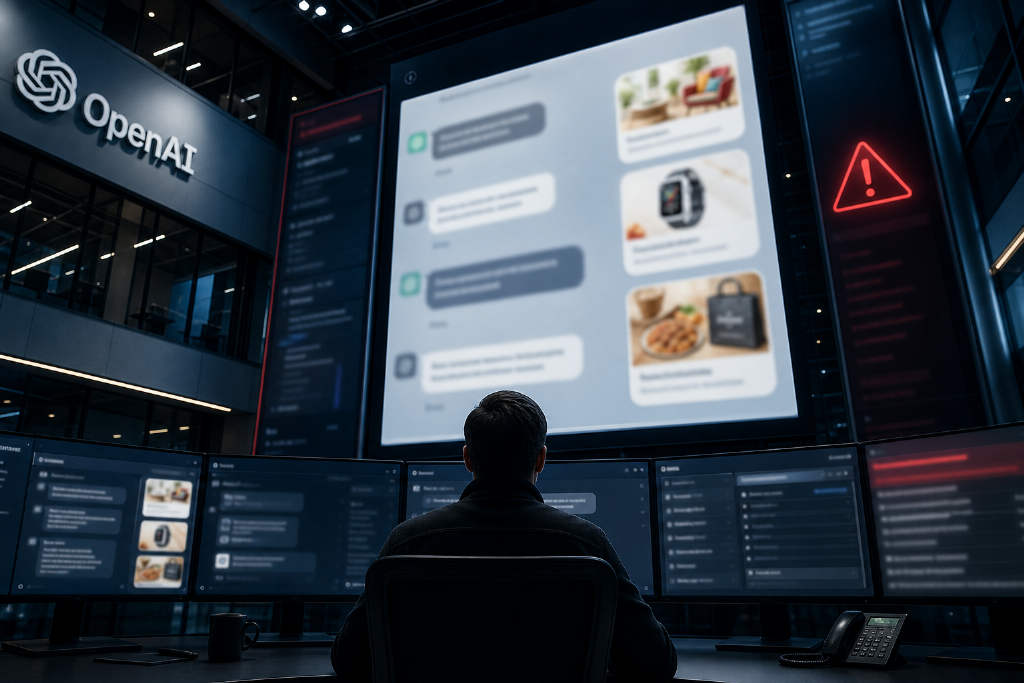
A new analysis by AI visibility platform Searchable found that ad relevance inside ChatGPT conversations still has room for improvement. The study reviewed more than 11,000 ads shown in ChatGPT chats between July 4 and Aug. 4, 2026. According to the findings, 33% of the ads were completely unrelated to the conversation, while only 27% directly matched the specific product a user was asking about. On a conversation basis, 40% of chats that included ads had at least one irrelevant ad, and in 28% of those chats, every ad shown was unrelated to the topic being discussed. The report also said 68% of ads appeared in conversations where users showed no purchase intent. The data adds context to OpenAI’s ad push. In June, OpenAI Chief Revenue Officer Denise Dresser said the rate at which users turn off ads had fallen by half since the advertising business launched in February.

180
Study finds 33% of ChatGPT ads were unrelated to conversation content
Unitree Robot
2026-08-20 04:09:00

Unitree founder Wang Xingxing says embodied AI could hit its ChatGPT moment in as little as two to three years

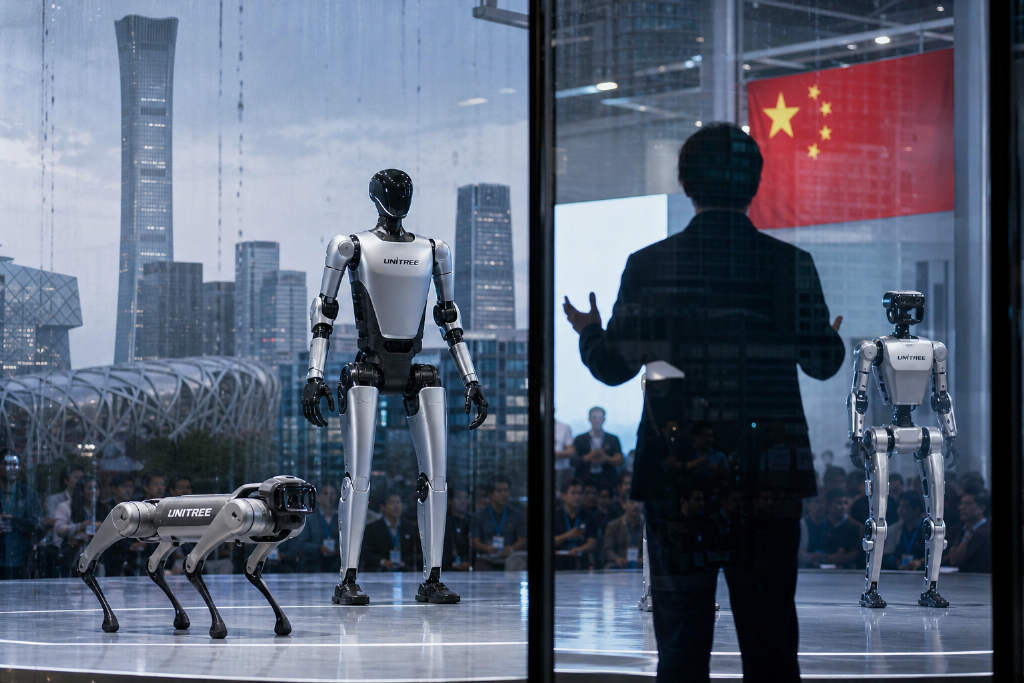
Wang Xingxing, founder of Unitree Robotics, said at the 2026 World Robot Conference that the biggest constraint on embodied intelligence is still weak generalization, and that the industry’s “ChatGPT moment” could arrive in as little as two to three years, or as long as five to ten years. Speaking a day after Unitree’s listing, Wang framed the next major milestone in simple terms: if a robot can be placed in a completely unfamiliar environment and complete roughly 80% of tasks through voice or language instructions alone, embodied AI will have crossed a key threshold. His speech also reviewed Unitree’s 10-year path from quadruped robots to humanoids and outlined a broad product lineup, including the G1 humanoid launched in 2024, the H1 platform, the GD01 mass-produced passenger-carrying transforming mech, the As2-W wheeled-quadruped robot, and the lightweight R1 humanoid. Wang said Unitree has been testing robots in auto factories and in its own facilities, but large-scale rollouts remain limited because robot efficiency and task transfer still lag. He also spent considerable time on data and model training, arguing that humanoid AI needs large volumes of human or internet data for pretraining, combined with real-robot data to align models with the physical world. Wang said the company is also exploring AI-driven self-improving robot development loops, where large models write control code, validate it in simulation, deploy it to physical machines, and refine it through model and human evaluation.

200
Unitree founder Wang Xingxing says embodied AI could hit its ChatGPT moment in as little as two to three years