Imran

Alliance
2026-09-09 03:50:09

Alliance co-founder says Coinbase and Robinhood are opening different crypto lanes

Alliance co-founder Imran Khan said Coinbase founder Brian Armstrong and Robinhood co-founder Vlad Tenev are moving into different parts of the crypto market based on their respective backgrounds. In his view, Robinhood has been built around retail trading and gives Vlad a strong read on the psychology and motivations of risk-seeking retail users, putting the platform in a better position to capture speculative activity and trading at the frontier of retail demand. Brian, by contrast, has spent more than a decade promoting Bitcoin and the broader crypto value system while operating inside Silicon Valley’s startup ecosystem. Khan said that background shapes Coinbase and Base toward building foundational financial infrastructure aimed at changing how the real world works. He added that overlap between the two businesses does not mean one must lose if the other gains, because the market is large enough for both. According to Khan, the two companies are likely to bring millions of new users on-chain through very different entry points.
100
Alliance co-founder says Coinbase and Robinhood are opening different crypto lanes
Alliance
2026-09-07 01:50:42

Alliance Co-founder: Public Chains Will Become Secondary, User-Facing Products Are Key

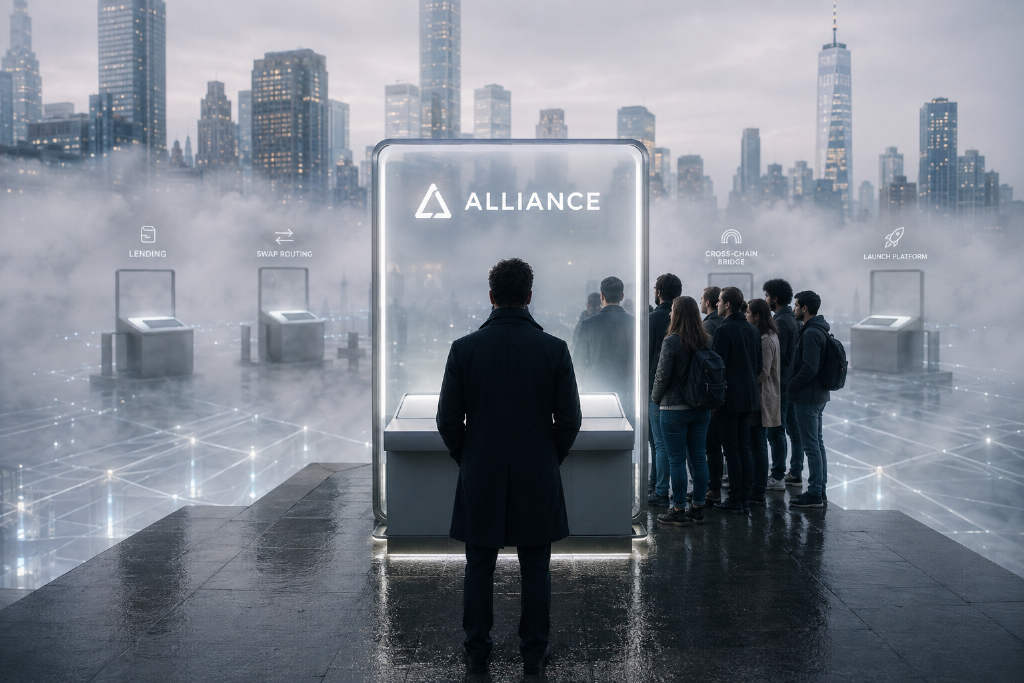
In a post on social media, Alliance co-founder Imran Khan stated that public chains will become secondary for most people, with the focus shifting to products that serve end users. He noted that launchpad platforms are being commoditized, and platforms with the deepest network effects or niche differentiation (e.g., stock trading pairs) will have an edge. Khan also argued that on-chain front ends are eroding the stickiness of single venues, as users can neutrally access multiple venues in one window, reducing switching costs. This trend extends to lending, swap routers, cross-chain bridges, and most trading infrastructure, with stickiness moving toward the party controlling user relationships.

330
Alliance Co-founder: Public Chains Will Become Secondary, User-Facing Products Are Key
Alliance
2026-09-07 01:48:48

Alliance Co-Founder: Public Chains Will Become Secondary for Most Users, Stickiness Shifts to Products

Alliance co-founder Imran Khan tweeted that public chains will become less important for most users, with the focus shifting to the products that serve end users. Launchpads are being commoditized, and platforms with deep network effects or niche differentiation (e.g., stock trading pairs) have an edge. On-chain frontends are weakening single-platform stickiness, as they allow neutral access to multiple venues from one window, lowering switching costs. Lending, exchange routing, bridges, and most trading infrastructure will follow the same trend, with stickiness moving to the party that controls the user relationship.

130
Alliance Co-Founder: Public Chains Will Become Secondary for Most Users, Stickiness Shifts to Products
Alliance
2026-08-27 06:05:22

Alliance co-founder says AI agents, not humans, may be crypto’s real users

Alliance co-founder Imran Khan argues that Chris Dixon’s core thesis on crypto remains largely intact: blockchains add an economic and ownership layer that the internet never fully built into its base architecture. In Khan’s view, early attempts to embed payments into the web, from Netscape’s work with Visa to the long-unused HTTP 402 status code, showed the idea was old even if the tooling was not ready. Crypto later introduced concepts such as user-owned assets, permissionless markets, decentralized identity, open social graphs, portable reputation, decentralized storage, and programmable finance, but most people never prioritized decentralization over convenience. That is where Khan sees AI changing the picture. He says AI agents are becoming a new class of internet participant and may be the real demand-side users for open protocols. As machine-to-machine activity grows, agents may need permissionless access to services, datasets, markets, identity systems, programmable money, storage, reputation, and discoverability across open networks. Khan’s broader conclusion is that the next internet will not be defined by crypto alone. He describes it as a stack shaped by crypto, AI, robotics, compute, energy, and eventually biotech, with crypto serving as the ownership layer and AI handling intelligence and interaction.

310
Alliance co-founder says AI agents, not humans, may be crypto’s real users
ChainFeeds
2026-08-19 01:56:38

ChainFeeds research digest covers Uniswap, Farcaster, Niulai meme frenzy and Hyperliquid

ChainFeeds’ Aug. 19 research digest pulls together five separate narratives shaping crypto and adjacent tech markets. The package starts with Uniswap founder hayden.eth arguing that automated market makers are still early and may gain their biggest edge in correlated trading pairs, where inventory risk is lower and liquidity can form naturally around asset clusters rather than defaulting to dollar pairs. IOSG Ventures then questions whether Model Fusion actually improves production economics, saying higher benchmark scores do not by themselves prove better ROI once token costs, latency and shared-model failure modes are counted. The digest also tracks the rapid deterioration of Farcaster’s business position. After Merkle Manufactory handed the protocol, app and Clanker over to Neynar in January and returned $180 million to investors, Neynar is now looking for yet another team to take over just seven months later. In another section, a small animated film titled Niulai became a meme phenomenon: a weak box office run turned into viral online attention, then spilled into BSC, where a same-name meme coin briefly reached a $46.79 million market cap. The final piece argues Hyperliquid is no longer just an onchain perpetuals venue, but a broader trading platform built around HyperCore, HyperEVM, HYPE and HIP-3.

610
ChainFeeds research digest covers Uniswap, Farcaster, Niulai meme frenzy and Hyperliquid
Farcaster
2026-08-18 08:32:35

Farcaster heads for a second handoff in a year as Neynar looks for a new team

Farcaster is back on the market less than a year after its first ownership transfer. On Aug. 17, Neynar co-founder rish said the company is looking for a new team to take over the Farcaster protocol, the official app, and token-launch platform Clanker. He added that Neynar will return its remaining funds and then disband the team. The move comes only seven months after Neynar took over the project from Farcaster’s original builder, Merkle Manufactory. In January, Merkle transferred the protocol contracts, codebase, official app, and Clanker to Neynar, while returning the full $180 million it had raised to investors. Founders Dan Romero and Varun Srinivasan then joined Tempo, a payments chain described in the source as a project incubated by Stripe and Paradigm. The business backdrop has shifted sharply since then. According to DefiLlama data cited in the article, Farcaster ecosystem protocol fees fell from $35.43 million in the first quarter of 2026 to $4.67 million in the second quarter, then to $377,000 from July 1 to Aug. 17, with only $4,001 generated in the past 24 hours. The article also said CLANKER token buybacks funded by fees have stopped. rish said operating the full-stack social network costs about $100,000 a month, peaking at $500,000, but argued the exit was not a financial decision.

490
Farcaster heads for a second handoff in a year as Neynar looks for a new team
onchain finan
2026-08-09 23:57:56

Alliance Co-founder: Pump-FOMO Rivalry Could Drive Onchain Finance Mainstream

Imran, co-founder of Alliance, said on X that competition between Pump and FOMO could become a key driver pushing onchain finance into the mainstream market. In his view, the rivalry between the two platforms would help onchain finance grow from a small niche within Crypto Twitter into a product designed for everyday consumers. He also pointed out that, alongside the rise of trading-focused content creators and trading-related content such as Market Bubble and Counterparty, the onchain finance industry may expand by at least one order of magnitude in the future. Previously, reports stated that pump.fun had launched an incentive program aimed at attracting users from the FOMO platform. According to disclosed protocol documents, pump.fun plans to provide qualified users with a one-time signing bonus of $20,000 and a fixed monthly payment of $30,000.

1120
Alliance Co-founder: Pump-FOMO Rivalry Could Drive Onchain Finance Mainstream
Alliance
2026-07-20 01:30:30

Alliance co-founder says neobanks and stablecoin platforms should build compliance first

Alliance co-founder Imran said on X that building a neobank or stablecoin business with high transaction volume and high TPV can be relatively easy when KYC, AML, transaction monitoring, and risk controls are loose. In that setup, platforms may gain growth quickly. He argued that the real test comes later: when bad actors show up, regulators start asking questions, or systems run into trouble. At that point, the key issue is whether the platform has the compliance infrastructure, internal controls, and legal protections needed to protect customers and keep operating. Imran said platforms should prioritize building that compliance foundation early, even if it means accepting slower growth at the start. He added that once weaker rivals run into regulatory or operational problems, firms with stronger controls may be in a position to capture users leaving those platforms.

1230
Alliance co-founder says neobanks and stablecoin platforms should build compliance first