STA

Policy Regula
2026-09-20 23:37:39

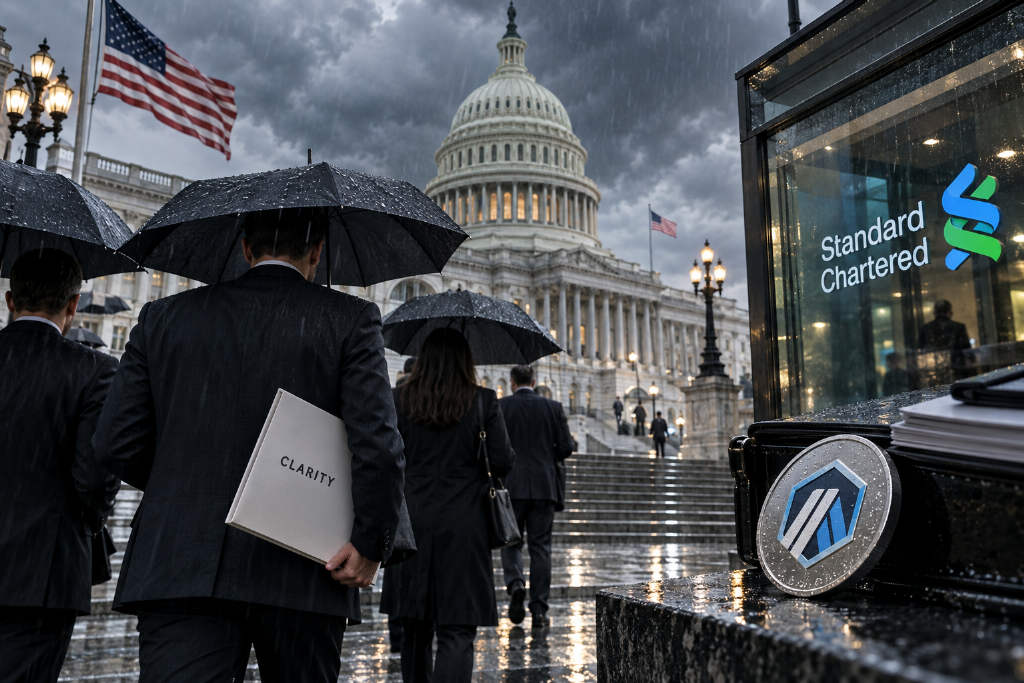
US Senate stalls CLARITY as SEC and CFTC move ahead, while Standard Chartered sees ARB at $10 by 2030

The US Senate failed to advance the Digital Asset Market Clarity Act after a cloture motion drew 49 votes in favor and 50 against, short of the 60 needed. Republican Senator Thom Tillis later said his “no” vote was procedural, leaving open the possibility of another vote, though time on the congressional calendar appears limited. In the gap left by stalled legislation, the US Securities and Exchange Commission rolled out a five-year exemption for limited trading of tokenized US stocks on decentralized public blockchains, while the Commodity Futures Trading Commission offered relief for passive software providers connecting users to regulated derivatives venues and submitted draft crypto rules to the White House. Separately, the House Financial Services Committee passed the American Reserve Modernization Act of 2026, which would put a Strategic Bitcoin Reserve into law, and the House Ways and Means Committee advanced the Digital Asset Tax Certainty Act. Outside Washington, Revolut faced a second ransom demand tied to stolen customer passport and KYC selfie data, Chainalysis reported a 420% rise in onchain malware-related activity over 12 months, and Standard Chartered said Arbitrum could reach $10 by 2030, implying roughly 70x upside from current levels.

270
US Senate stalls CLARITY as SEC and CFTC move ahead, while Standard Chartered sees ARB at $10 by 2030
Whale Movemen
2026-09-20 09:30:00

PA Daily: Strategy jumps 48% in a month as PlanB says Bitcoin bear market is over

PANews’ latest daily roundup spans market calls, security incidents, project updates, regulation and whale activity across crypto. Among the headline items, analyst PlanB said Bitcoin has moved above its 50-week moving average at about $79,000 and is now targeting the 100-week moving average near $89,000, arguing that the bear market has ended. On the equities side, Cointelegraph reported that MicroStrategy, trading as MSTR, was the best-performing Nasdaq-100 component over the past month with a 48% gain. The report also covered a major fraud case in Istanbul involving more than $3 billion, where authorities arrested 191 suspects in a cross-agency operation. In the U.S., Kalshi and Kraken parent Payward filed applications tied to perpetual contracts linked to individual stocks. Project-side developments included Universal’s planned wind-down over 60 days, MultiversX pausing its mainnet after confirming an attack attempt, and a dispute between Chengming Technology and Zhipu over alleged unauthorized data uploads by the ZCode client. Security and on-chain data featured heavily as well. Forbes reported that North Korea-linked hackers infected more than 30,000 devices through fake job offers and stole data from over 7,000 crypto wallets, with at least $10.71 million flowing to attacker-controlled wallets. PANews also highlighted losses at Fetch.ai and NuNet, several large leveraged positions, and comments from Michael Saylor, Vitalik Buterin, Peter Schiff, Jiang Zhuoer and ZachXBT.

420
PA Daily: Strategy jumps 48% in a month as PlanB says Bitcoin bear market is over
CXMT
2026-09-20 11:21:11

CXMT says G5 DRAM platform has entered mass production, with economics still under scrutiny

Changxin Memory Technologies, or CXMT, said at the 2026 World Manufacturing Convention on Sept. 20 that its fifth-generation DRAM technology platform, G5, has entered mass production, alongside two 24Gb LPDDR5X products built on the node. The company highlighted four figures: an 11.95 nm active-area half-pitch, a capacitor aspect ratio of 45:1, a 6,762 nm core functional area height, and at least a 50% increase in dies per wafer versus the prior generation. The announcement matters less because of the “fifth-generation” label than because of how CXMT got there. The article argues that, without access to EUV lithography tools in mainland China, the company has pushed its process to roughly the industry’s 1c-class range using DUV multi-patterning and a broader stack of process modules, including HKMG and other structural changes. That said, node alignment does not mean cost alignment. The reported 50% gain refers to dies per wafer on an 8Gb-equivalent basis before yield screening, not to sellable output. CXMT did not disclose G5 yield or monthly production. The piece says the real questions now are how quickly yield improves, how fast cost per bit converges with the three global leaders, and whether HBM can move from reported trial production to an officially confirmed product line.

310
CXMT says G5 DRAM platform has entered mass production, with economics still under scrutiny
MetaDAO
2026-09-20 04:21:10

Alea says MetaDAO has no shortage of buyers, but needs more companies worth funding

Alea Research argues that MetaDAO’s bottleneck is no longer investor demand. Since its first sale in April 2025, the platform has recorded $624.7 million in subscriptions across 23 public offerings, accepted $45.4 million, and refunded the rest. Twenty-two of the 23 sales still met their fundraising targets. In Alea’s framing, that pattern matters because MetaDAO does not hand capital over to founders and walk away. Treasury funds, intellectual property, and the right to issue more tokens remain under the control of META holders through decision markets. The report contrasts that structure with earlier fundraising models, from Regulation Crowdfunding and Regulation A+ to SPACs, ICOs, and low-float token launches. Those systems expanded access to buyers, Alea says, but largely stopped at the point of sale, leaving investors with little control over how proceeds were used. MetaDAO’s pitch is different: token buyers get live pricing, binding influence over treasury decisions, and exit routes that do not depend on finding a corporate acquirer. Alea also says MetaDAO’s revenue model explains why company selection now matters more than demand generation. The protocol charges 0.50% per trade on its Futarchy AMM, so fee income tends to lag fundraising activity by about a quarter. With buyers already showing up, the report says the harder task is building a pipeline of companies that can absorb capital under the platform’s governance structure.

260
Alea says MetaDAO has no shortage of buyers, but needs more companies worth funding
YMTC
2026-09-20 00:58:15

YMTC’s STAR Market IPO Is Accepted After a 333.79 Billion Yuan Quarterly Profit, but the Cycle Question Remains

Yangtze Memory Technologies Co. (YMTC) has moved one step closer to a STAR Market listing after the Shanghai Stock Exchange updated its review status to "accepted." The company plans to issue 1.98 billion to 2.43 billion shares and raise 33 billion yuan, with 20.8 billion yuan earmarked for mass-production line upgrades and 12.2 billion yuan for research and development. By the proposed fundraising size, the deal is the largest IPO application ever filed on the STAR Market. The filing shows a dramatic financial turnaround. Revenue rose from 18.744 billion yuan in 2023 to 63.185 billion yuan in 2025, while attributable net profit swung from a 19.181 billion yuan loss in 2023 to a 6.771 billion yuan profit in 2024 and 14.211 billion yuan in 2025. In the first quarter of 2026 alone, YMTC posted 47.042 billion yuan in revenue and 33.379 billion yuan in net profit attributable to shareholders, more than twice its full-year 2025 profit. Still, the prospectus also lays out the tension behind those numbers: margins surged with NAND pricing, but the company remains exposed to a heavy depreciation burden, negative free cash flow in 2025, rising receivables, inventory write-down pressure, and supply-chain constraints. The filing presents YMTC as a company benefiting from an AI-driven memory upcycle while still carrying the structural risks of a capital-intensive, highly cyclical NAND business.

320
YMTC’s STAR Market IPO Is Accepted After a 333.79 Billion Yuan Quarterly Profit, but the Cycle Question Remains
medical devic
2026-09-20 01:00:09

Hospital-focused device makers face margin pressure as Mindray, United Imaging and Weigao push into home medical devices

China’s hospital-facing medical device business is losing much of the pricing power that once made it highly profitable. The article says volume-based procurement, aggressive price competition and slower payment collection are squeezing margins across both high-value consumables and medical equipment. Financial figures cited for companies including Weigao Orthopaedics, Wandong Medical and United Imaging show how the pressure has spread from manufacturers to distributors. At the same time, the home medical device market has continued to expand. The report says China’s market grew from RMB 53.3 billion in 2017 to RMB 168.2 billion in 2023, with LeadLeo forecasting RMB 178.4 billion in 2026. Against that backdrop, major hospital-market players such as Mindray, Weigao and United Imaging have stepped up efforts in wearables, oxygen concentrators, hearing aids, continuous glucose monitoring systems and other household products. The piece argues that this shift is not a move into an easy, high-margin segment. Home medical devices are already crowded, with price wars in categories such as CGM and intense competition in hearing aids. Still, hospital-market leaders are betting that their clinical R&D capabilities and links to hospital systems can help them build integrated care products that extend from hospitals into the home.

220
Hospital-focused device makers face margin pressure as Mindray, United Imaging and Weigao push into home medical devices
stablecoins
2026-09-18 10:01:53

Stablecoins and RWA Are Moving From Tokenized Assets to Real-World Payments

A Foresight article argues that the story around stablecoins and real-world assets, or RWA, is shifting away from simply issuing more tokens and toward building a financial network that can actually function end to end. The piece says the market is now focusing on whether tokenized assets can be issued in compliance, traded with investor rights intact, settled onchain, and eventually used in everyday payment scenarios. It points to several recent developments across traditional finance and crypto. The New York Stock Exchange said in January that it was developing a tokenized securities platform designed to support shareholder rights, 24/7 trading, fractional shares, instant settlement, and stablecoin-based cash settlement. Later, it brought in Securitize and tZERO to add infrastructure around transfer agency, broker-dealer services, securities registration, and onchain settlement. On the crypto side, Bitfinex Securities recently launched five products that give qualified investors economic exposure to listed companies including Strategy and Metaplanet. The article also highlights a payments push in Japan. HashPort and Lawson tested an in-store yen stablecoin payment in Tokyo in August, while NETSTARS completed a Stablecoin Pay proof of concept at another Lawson store. On Sept. 3, imToken and NETSTARS signed an MOU to explore connecting imToken wallet infrastructure with Stablecoin Pay.

400
Stablecoins and RWA Are Moving From Tokenized Assets to Real-World Payments
Bitcoin
2026-09-18 08:57:00

Bitcoin Holds Above Weekly Lows as SEC Exemption and Sept. 25 Options Expiry Move Into Focus

A market note jointly published by PANews and BIT US Stocks said Bitcoin has absorbed two back-to-back shocks this week — a legislative setback and a rate decision — without breaking its Tuesday low near $75,000. The report said traders are now watching the Sept. 25 quarterly options expiry, which accounts for about 43% of Bitcoin open interest, with max pain near $72,000 and a visible call wall around $85,000. It also pointed to mixed positioning data: CryptoQuant’s bull score fell from 80 to 60, the Fear and Greed Index stayed at 69 in the greed zone, and Glassnode said listed-company treasuries added only about 5,900 BTC over the past three months, well below the same period last year. Beyond crypto, the note highlighted a rebound in U.S. equities led by AI and semiconductor names, while the U.S. Securities and Exchange Commission’s five-year exemption for tokenized stock trading was described as a direct positive for trading venues and on-chain financial infrastructure. Crypto-linked stocks and miners also advanced, even as the report warned that Friday’s triple witching session could amplify volatility across markets.

520
Bitcoin Holds Above Weekly Lows as SEC Exemption and Sept. 25 Options Expiry Move Into Focus