ASP

Sandisk
2026-08-14 05:45:35

Sandisk lays out 80% gross margin floor as HBF becomes central to long-term growth case

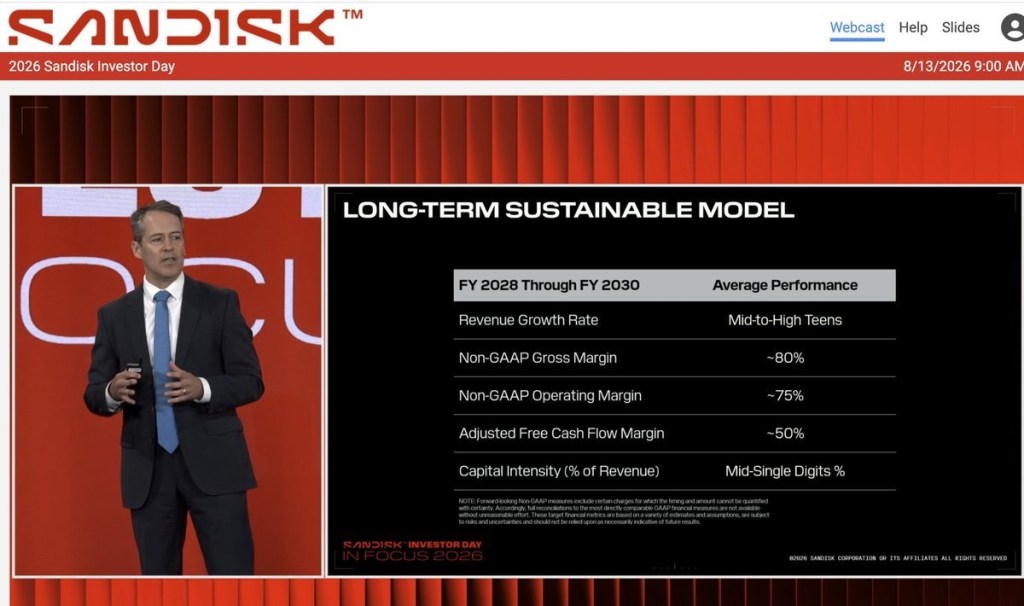
Sandisk used its Aug. 13 investor day to lay out a long-range financial model that sits well above market expectations and puts its in-house High Bandwidth Flash, or HBF, at the center of the story. The company said its long-term sustainable model, based on average performance across FY2028 to FY2030, calls for revenue growth in the mid-to-high teens, a Non-GAAP gross margin of about 80%, a Non-GAAP operating margin of roughly 75%, adjusted free cash flow margin near 50%, and capital intensity in the mid-single digits as a percentage of revenue. Mizuho Securities kept its Outperform rating on Sandisk and set a $1,900 price target, arguing that the company’s framework, buyback capacity, and exposure to AI infrastructure support upside. Sandisk also detailed the positioning of HBF, saying the product can deliver comparable read bandwidth to HBM at about one-eighth the cost, while offering 8x to 16x more capacity in a similar package footprint. The company tied that pitch to memory-heavy AI inference workloads and said HBF is meant to work alongside HBM rather than replace it.

730
Sandisk lays out 80% gross margin floor as HBF becomes central to long-term growth case
Taiwan
2026-08-14 02:13:15

Taiwan FSC proposes tighter VASP travel rule, requiring identity data for transfers above NT$30,000

Taiwan’s Financial Supervisory Commission on Aug. 13 released a draft amendment to the anti-money laundering and counter-terrorism financing rules for virtual asset service providers, refining how the travel rule would apply to crypto transfers. The proposal aligns with Recommendation 16 revised by the Financial Action Task Force in June and sets NT$30,000 as the threshold for more detailed data collection. For transfers below that level, VASPs would only need the sender’s and recipient’s names and wallet information. Once a transfer exceeds NT$30,000, the sending VASP would need to collect added identity details, including date of birth and residential address for natural persons, or official identification number and registered address for legal entities. The draft also adds a matching obligation for receiving VASPs, which would need to compare recipient data against information sent by the originating firm. If required information cannot be obtained and transmitted, the transfer could not proceed. Public comments are open until Sept. 14, while the detailed implementation scope and timeline would be set by the industry association and submitted to the FSC for approval.

1010
Taiwan FSC proposes tighter VASP travel rule, requiring identity data for transfers above NT$30,000
South Korea
2026-08-13 14:40:34

Delio CEO Sentenced to 15 Years in South Korean Crypto Deposit Fraud Case

Jeong Sang-ho, CEO of South Korean crypto lending platform Delio, was sentenced to 15 years in prison by the Seoul Southern District Court on Aug. 13 in a fraud and embezzlement case, according to The Block. The court ordered Jeong remanded into custody over flight risk; prosecutors had sought a 20-year term. He was convicted of using falsified documents to obtain a virtual asset service provider (VASP) registration and of misappropriating user assets. The sum tied to the conviction is roughly 70 billion won (about $49.2 million). A separate major fraud charge, involving about 2,800 victims and 250 billion won (around $175.6 million), was acquitted. Delio abruptly halted withdrawals in June 2023 and declared bankruptcy in November 2024, leaving many depositors' assets frozen. The verdict shows South Korea is stepping up enforcement against crypto operators that collect deposits improperly. For depositors, it establishes criminal liability, yet how much of the frozen funds can be recovered remains another long process.

850
Delio CEO Sentenced to 15 Years in South Korean Crypto Deposit Fraud Case
Delio
2026-08-13 10:16:50

Delio CEO Sentenced to 15 Years in South Korea Over $49 Million Crypto Fraud Case

A South Korean court has sentenced Delio CEO Jeong Sang-ho to 15 years in prison over the collapse of the crypto deposit platform, convicting him on a narrower set of charges worth roughly 70 billion won, or about $49 million. The ruling came after the court threw out Delio server database evidence, finding that prosecutors failed to properly protect the company’s right to participate in a search and seizure at server host Gabia and did not provide a list of seized items. That decision wiped out much of the original indictment, which had alleged fraud involving about 2,800 victims and roughly 250 billion won, or about $176 million, between August 2021 and June 2023. The court also found Jeong guilty of registering Delio as a virtual asset service provider with a falsified accounting firm report that allegedly overstated coin holdings by about 47.6 billion won. Judges said Jeong dishonestly obtained his license, promoted Delio as a crypto bank despite lacking the ability to run it, and blamed bankruptcy for failing to return customer assets. The verdict had been scheduled for July 16 but was delayed after the evidence dispute reopened arguments.

360
Delio CEO Sentenced to 15 Years in South Korea Over $49 Million Crypto Fraud Case
South Korea
2026-08-13 06:17:55

South Korea Expands VASP Registration Review to Major Shareholders Starting Aug. 20

South Korea is set to broaden the scope of its registration review for virtual asset service providers (VASPs) to include major shareholders, with the change scheduled to take effect on August 20, according to News1. Under the updated rules, operators will be required to give financial authorities 30 days' advance notice in the event that major shareholders or the company's legal compliance framework undergo any changes. The revised registration handbook was released during a briefing in Seoul hosted by the Financial Intelligence Unit (FIU) and the Financial Supervisory Service (FSS), which was intended for VASPs and prospective operators. The review now covers the largest shareholder, shareholders with a stake of at least 10%, and shareholders with a special relationship to the largest shareholder. Where the largest shareholder is a legal entity, the entity's own largest shareholder and its representatives may also be brought under review. The details emerged from a session that brought together existing service providers and firms considering entry into the sector.

930
South Korea Expands VASP Registration Review to Major Shareholders Starting Aug. 20
Yellow Card
2026-08-13 06:00:14

Yellow Card Raises $40 Million After Exiting Its Consumer App to Focus on Stablecoin Infrastructure

Stablecoin infrastructure provider Yellow Card said on Aug. 4 that it had raised $40 million in a strategic financing round backed by SC Ventures, Sony Innovation Fund, Polychain Capital, and Blockchain Capital, lifting its total equity funding to more than $120 million. The company’s path to this point took nearly a decade and included two major shifts: from a Bitcoin gift card product launched in 2016, to a retail crypto trading app in Nigeria in 2019, and then to a business focused on enterprise stablecoin infrastructure after demand moved sharply from Bitcoin to USDT. During the pandemic, Yellow Card’s transaction volume rose from $1 million per month to $1 million per day, and after listing USDT, 99% of volume shifted from Bitcoin to stablecoins in four months. The company later decided to shut its consumer mobile app, telling retail users on Oct. 29, 2025 to withdraw funds by Dec. 31 before the app closed on Jan. 1, 2026. Yellow Card now positions itself as a payments and settlement infrastructure provider for banks, fintech firms, and enterprises across emerging markets, with operations in more than 50 markets and licenses, authorizations, or registrations in 22 jurisdictions as of August 2026.

470
Yellow Card Raises $40 Million After Exiting Its Consumer App to Focus on Stablecoin Infrastructure
MiCA
2026-08-13 02:07:20

Why the EU’s CASP license is becoming essential after MiCA’s transition period ends

A MarsBit article argues that the European Union’s Crypto-Asset Service Provider, or CASP, authorization is moving from a nice-to-have credential to a core market-access requirement for firms serving EU crypto clients. The shift is tied to July 1, 2026, when MiCA’s longest transition period for existing crypto-asset service providers ends across the bloc. Firms that had operated under older member-state rules but failed to secure MiCA authorization are expected to carry out orderly exit plans, stop providing unauthorized crypto-asset services to EU customers, and properly handle existing client relationships and asset transfers. The piece says MiCA changes more than the label on a license. It replaces Europe’s fragmented model of separate national registrations with a framework built on unified authorization, common standards, and cross-border operations through formal notification procedures. At the same time, CASP does not function as a blanket permit. Its scope depends on the actual services provided, and it does not automatically cover areas such as payments, e-money activity, fiat account services, card issuance, or products that fall under securities rules such as MiFID II. The article also notes that ESMA expects a narrow reading of reverse solicitation, making it harder for non-EU firms to rely on offshore structures while still targeting European users.

850
Why the EU’s CASP license is becoming essential after MiCA’s transition period ends
ESMA
2026-08-12 14:14:54

ESMA Adds Slovenia's Dinaro to MiCA Register as First EMT Issuer From the Country

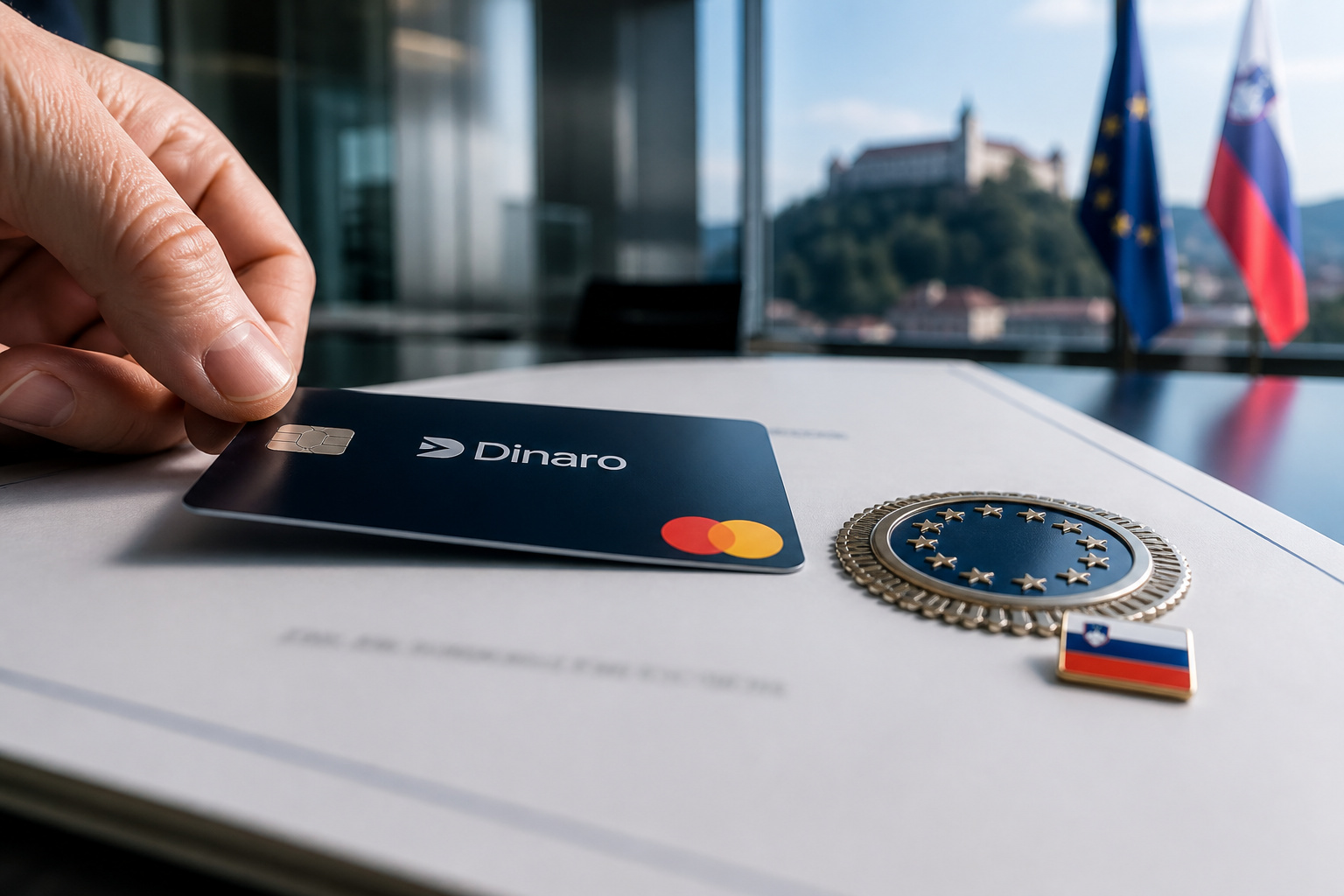
The European Securities and Markets Authority (ESMA) refreshed its MiCA register on Wednesday, adding Dinaro, a Slovenian e-money institution, to the list of electronic money token (EMT) issuers — the first time a Slovenian firm has entered that register, according to Cointelegraph. Dinaro is supervised by the Bank of Slovenia and offers payment services spanning card issuance and acquiring; it also holds principal membership with Mastercard, which enables direct card issuing on the network. The update brings the total number of registered EMT issuers to 43, while the asset-referenced token (ART) list remains empty. ESMA's register of non-compliant entities is unchanged at 167. In the crypto-asset service provider (CASP) category, the regulator added two institutions in this cycle: Czech bank Partners Banka and Germany's Volksbank Beilstein-Ilsfeld-Abstatt. CASP registrations now stand at 325. Czech firm Altlift, which had been included in early July, has been removed from the roster.

950
ESMA Adds Slovenia's Dinaro to MiCA Register as First EMT Issuer From the Country