ASP

Germany
2026-08-24 11:14:01

Germany’s authorized CASPs rise to 79 as six cooperative banks join EU register

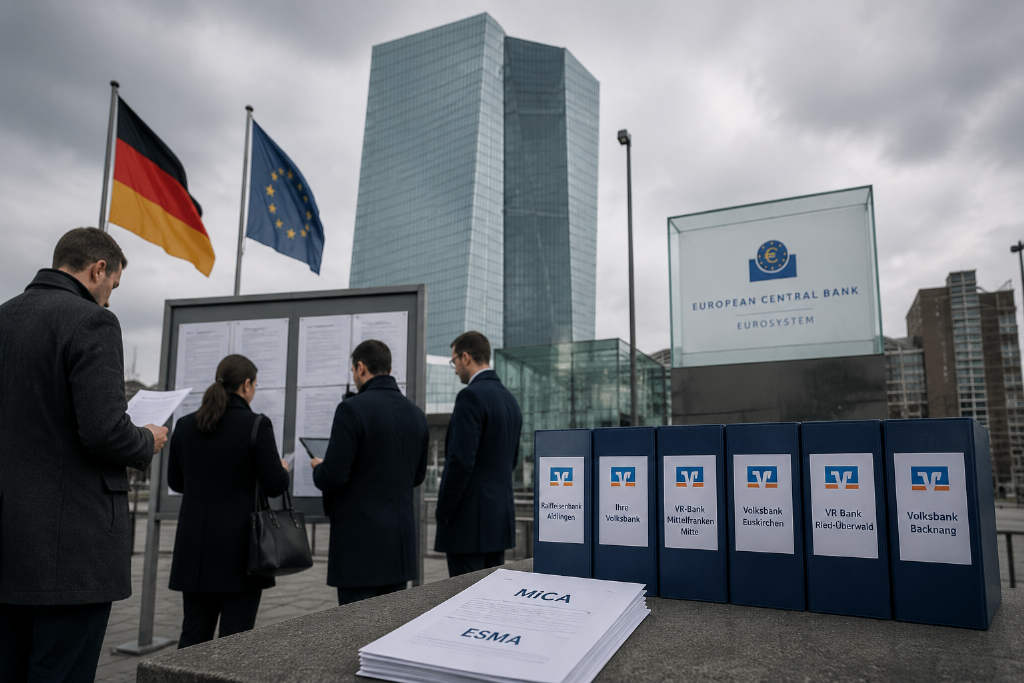
The European Securities and Markets Authority has updated its register under the Markets in Crypto-Assets Regulation, bringing the total number of authorized crypto-asset service providers in the EU to 331. The six newly added entities are all German cooperative banks: Raiffeisenbank Aidlingen, Ihre Volksbank, VR-Bank Mittelfranken Mitte, Volksbank Euskirchen, VR Bank Ried-Überwald and Volksbank Backnang. Germany now has 79 authorized CASPs, ahead of France with 35 and the Netherlands with 29. According to Germany’s financial watchdog, the country’s lead is linked to its large financial sector, the number of credit institutions able to offer crypto services, and the role of both the national licensing regime and the transition period, which allows some providers to obtain authorization through a simplified process. The update also leaves the asset-referenced token register empty, keeps the electronic money token register at 43 entries, and maintains the list of non-compliant entities at 167.
610
Germany’s authorized CASPs rise to 79 as six cooperative banks join EU register
Germany
2026-08-24 11:13:58

Germany Adds Six Banks to MiCA Register as Authorized Firms Reach 79

ESMA has updated its MiCA interim register to add six German cooperative banks as crypto-asset service providers (CASPs), bringing the country’s total authorized firms to 79. Germany remains the EU leader by count, ahead of France at 35 and the Netherlands at 29. The bloc’s total number of CASP authorizations has risen to 331, according to crypto.news.

430
Germany Adds Six Banks to MiCA Register as Authorized Firms Reach 79
Germany
2026-08-24 11:12:56

Germany Adds Six Cooperative Banks to MiCA Register, Extends Lead With 79 Authorized CASPs

The European Securities and Markets Authority updated its MiCA register on Aug. 24, bringing the EU-wide total of authorized crypto-asset service providers, or CASPs, to 331. Germany added six cooperative banks in the latest update and now has 79 authorized CASPs, well ahead of France's 35 and the Netherlands' 29. The new German additions are Raiffeisenbank Aidlingen, Ihre Volksbank, VR-Bank Mittelfranken Mitte, Volksbank Euskirchen, VR Bank Ried-Überwald and Volksbank Backnang. The latest update also left the ART register empty, kept EMTs at 43 and unchanged the list of non-compliant entities at 167.
370
Germany Adds Six Cooperative Banks to MiCA Register, Extends Lead With 79 Authorized CASPs
MiCA
2026-08-24 10:50:53

Germany widens MiCA lead as EU-authorized CASPs rise to 331

Germany extended its lead in authorizations under the European Union’s Markets in Crypto-Assets Regulation after the European Securities and Markets Authority updated its register on Friday. The total number of authorized crypto asset service providers, or CASPs, rose to 331, with all six newly added firms coming from Germany’s cooperative banking sector. The additions were Raiffeisenbank Aidlingen, Ihre Volksbank, VR-Bank Mittelfranken Mitte, Volksbank Euskirchen, VR Bank Ried-Überwald and Volksbank Backnang. That pushed Germany’s total to 79 CASPs, well ahead of France at 35 and the Netherlands at 29. ESMA data previously reviewed by Cointelegraph showed Germany had already been in front in late June with 57 authorized providers. Germany’s Federal Financial Supervisory Authority, or BaFin, said in June that the country’s higher authorization count partly reflected the size of its financial sector and the number of credit institutions eligible to offer crypto services. BaFin also pointed to Germany’s existing national licensing framework, which allowed some firms to use simplified procedures while moving into the MiCA regime. ESMA’s ART, EMT and non-compliant entity datasets were unchanged, with the ART register empty, the EMT register at 43 entries and the non-compliant entity list at 167.

490
Germany widens MiCA lead as EU-authorized CASPs rise to 331
South Korea
2026-08-24 08:16:00

South Korea plans Digital Asset Basic Act for this fall

South Korea’s top financial regulator will speed up discussions on crypto-related legislation and aims to introduce the country’s version of the Digital Asset Basic Act this fall, according to The Block. Based on the information disclosed so far, the bill is expected to set rules for stablecoin issuance, licensing for virtual asset service providers, or VASPs, and Bitcoin exchange-traded funds, or ETFs. The update points to a faster policy timetable as regulators move to formalize key parts of the country’s digital asset framework. No additional details on the draft text or implementation schedule were provided in the report cited.

360
South Korea plans Digital Asset Basic Act for this fall
TRON
2026-08-24 07:57:46

TRON weekly report tracks BTC’s run toward $80,000 and spotlights Cap, Ground, and shifting crypto rules

TRON’s latest weekly industry report, covering Aug. 16 to Aug. 23, said crypto markets rebounded sharply as macro pressure, liquidity expectations, and friendlier U.S. policy signals converged. Bitcoin climbed from about $62,819 on Aug. 16 to an intraday high near $79,306 on Aug. 21 before easing back to roughly $76,000-$76,300 by Aug. 23, a gain of about 21% for the period. Ether rose from around $1,876 to about $2,390, with a weekly increase of roughly 27% and a peak near $2,544 on Aug. 21. TRON linked the move to an expanded long-dated Treasury buyback plan from the U.S. Treasury, a warmer regulatory backdrop including renewed momentum for the CLARITY Act and a new Securities and Exchange Commission proposal for crypto asset issuance, plus about $1.6 billion in net inflows into U.S. spot Bitcoin ETFs from Aug. 17 to Aug. 20. The report also focused on two institutional on-chain yield projects. Cap, which has raised $15.4 million with participation from Franklin Templeton, Triton Capital, GSR, and Flow Traders, is presented as a credit-backed, yield-bearing stablecoin system on Ethereum built around underwriters, overcollateralization, liquidation, and integration with Symbiotic restaking infrastructure. Ground, which has raised $3.6 million led by Bain Capital and ParaFi with backing from Nascent, Robot Ventures, and Chapter One, is described as an institutional yield infrastructure layer that connects stablecoin balances to multiple on-chain yield sources through APIs, portfolio wallets, routing, and non-custodial key management. The report further reviewed fresh SEC, CFTC, CLARITY Act, and MiCA developments.

550
TRON weekly report tracks BTC’s run toward $80,000 and spotlights Cap, Ground, and shifting crypto rules
Pakistan
2026-08-24 05:32:59

Pakistan opens crypto licensing portal, sets Sept. 5, 2026 deadline for existing VASPs

Pakistan has opened a licensing application portal for virtual asset service providers, or VASPs, according to Techub News, which cited Cointelegraph. Under the country’s new regulatory framework for crypto assets, existing VASPs are required to submit applications for a no-objection certificate, or NOC, by Sept. 5, 2026. Firms that fail to do so face the prospect of being forced to stop operations. The update points to a formal application process now being put in place for crypto service providers already operating in the market. No additional details on the scope of the portal, the application process, or the number of affected firms were provided in the source item.

310
Pakistan opens crypto licensing portal, sets Sept. 5, 2026 deadline for existing VASPs
Pakistan
2026-08-24 05:17:57

Pakistan opens crypto licensing portal, sets Sept. 5 deadline for existing firms

Pakistan’s Virtual Assets Regulatory Authority has opened its licensing portal after notifying rules for crypto exchanges and other virtual asset service providers operating in the country. Firms that were already providing virtual asset services on or before March 5 must apply for a no-objection certificate by Sept. 5 or stop operating. The new framework covers exchanges, custody, broker-dealer services, lending, derivatives, asset management, token issuance and mining-related services. It also gives firms two routes: a sandbox for testing products under supervision and an NOC pathway before local incorporation. Licensed providers must keep customer assets separate, and they cannot lend or pledge them without written consent. The rollout follows a public consultation held from June 11 to July 2. Pakistan’s parliament passed the Virtual Assets Act in March, and the State Bank of Pakistan later allowed banks to provide accounts to licensed VASPs, including segregated client-money accounts.

320
Pakistan opens crypto licensing portal, sets Sept. 5 deadline for existing firms