TSVs

SEC
2026-09-18 02:03:54

SEC opens path for tokenized NMS stock trading as ZEC short whale tops $26 million in unrealized losses

Crypto markets on Sept. 18 were driven by a mix of regulation, whale positioning and private-market fundraising. The U.S. Securities and Exchange Commission issued a five-year “innovation exemption” that would let tokenized securities venues trade tokenized National Market System stocks through permissioned AMM liquidity pools under a set of conditions. On-chain tracker Lookonchain said Garrett Jin, described as the largest on-chain ZEC short, is now sitting on more than $26 million in unrealized losses and moved roughly $85 million in ETH from Binance to Hyperliquid to defend the position. Bloomberg also reported that Manus, a China-founded AI startup, is working on a roughly $500 million financing that could lift its valuation to $4 billion. Elsewhere, Arthur Hayes commented on FLOP testnet trading and the macro effect of Fed hikes, Matt Huang argued that Zcash’s developer fund remains important for long-term resilience, and Standard Chartered revised its Fed call to a 25-basis-point hike in December 2026.
390
SEC opens path for tokenized NMS stock trading as ZEC short whale tops $26 million in unrealized losses
SEC
2026-09-18 09:10:00

SEC opens temporary path for tokenized stock trading as spot Bitcoin ETFs add $159 million

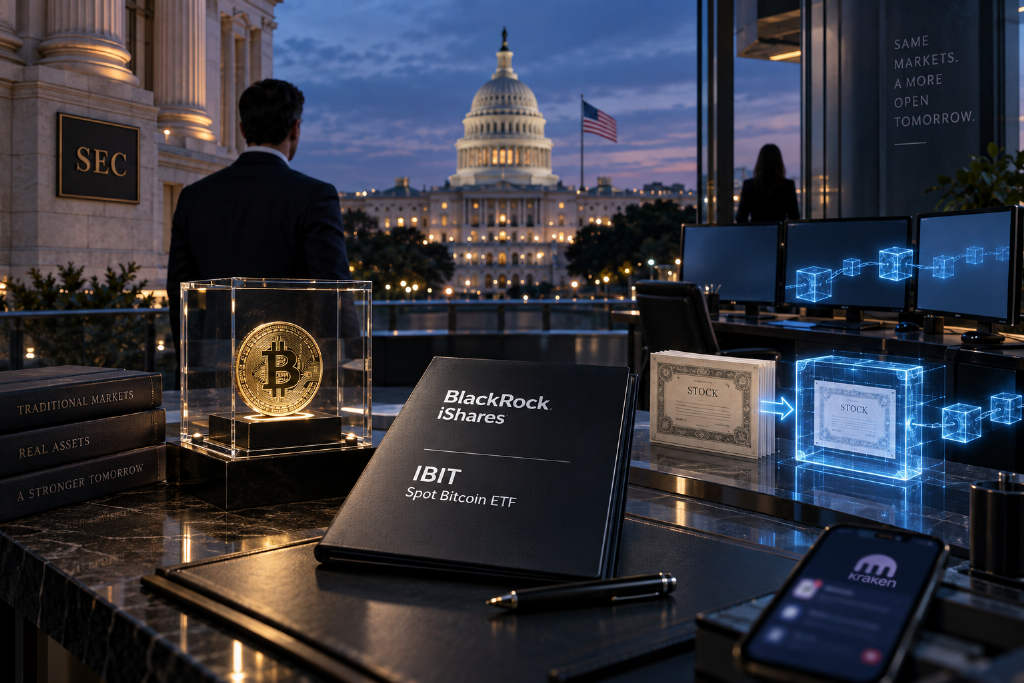
The U.S. Securities and Exchange Commission approved an "innovation exemption" that creates a temporary, conditional route for on-chain trading of certain tokenized NMS stocks, with SEC Chair Paul S. Atkins laying out four core requirements. Those include U.S.-based venues, permissioned access, a ban on synthetic tokenized equities, and an issuer opt-out right backed by a 30-day notice process. The agency also said token holders must receive rights equivalent to those attached to traditional securities, including dividends and voting rights. Elsewhere, U.S. spot Bitcoin ETFs posted $159 million in net inflows on Sept. 17, according to SoSoValue. BlackRock's IBIT was the only fund with net inflows, adding $184 million, while Fidelity's FBTC saw the largest daily outflow at $16.6386 million. Total net assets across spot Bitcoin ETFs stood at $96.247 billion, with a net asset ratio of 6.26% and cumulative historical net inflows reaching $54.728 billion. The day also brought a wide set of market and project updates: a Bitcoin whale moved 1,651.82 BTC to Kraken, Hyperliquid launched manual borrowing against HYPE and BTC, Across Protocol began its transition to AcrossCo with ACX set to lose all functions after Jan. 8, 2027, and Nostra paused lending after an oracle manipulation incident on Starknet.

580
SEC opens temporary path for tokenized stock trading as spot Bitcoin ETFs add $159 million
AMC Entertain
2026-09-18 00:02:36

AMC CEO backs SEC tokenized stock framework and urges Robinhood to match it overseas

AMC Entertainment CEO Adam Aron said on X that he supports the tokenized stock policy outlined by U.S. Securities and Exchange Commission Chair Paul Atkins, highlighting three points he sees as essential. Aron said investor protection must remain in place, synthetic assets should not be used, and stock issuers should have the right to object to their securities being traded on tokenized securities venues. He added that, under the SEC framework, eligible stock tokens should carry full voting rights and dividend rights, and public companies should be able to block tokenized trading of their shares. Aron also addressed Robinhood co-founder Vlad Tenev directly, calling on the company to apply the same standards to its overseas stock token business. His comments came after the SEC approved a temporary, conditional Innovation Exemption that allows limited trading of tokenized stocks on certain on-chain venues known as tokenized securities venues, or TSVs.

280
AMC CEO backs SEC tokenized stock framework and urges Robinhood to match it overseas
SEC
2026-09-18 02:10:00

SEC opens a limited path for on-chain tokenized stocks as ZEC volatility and whale flows dominate Sept. 18 market watch

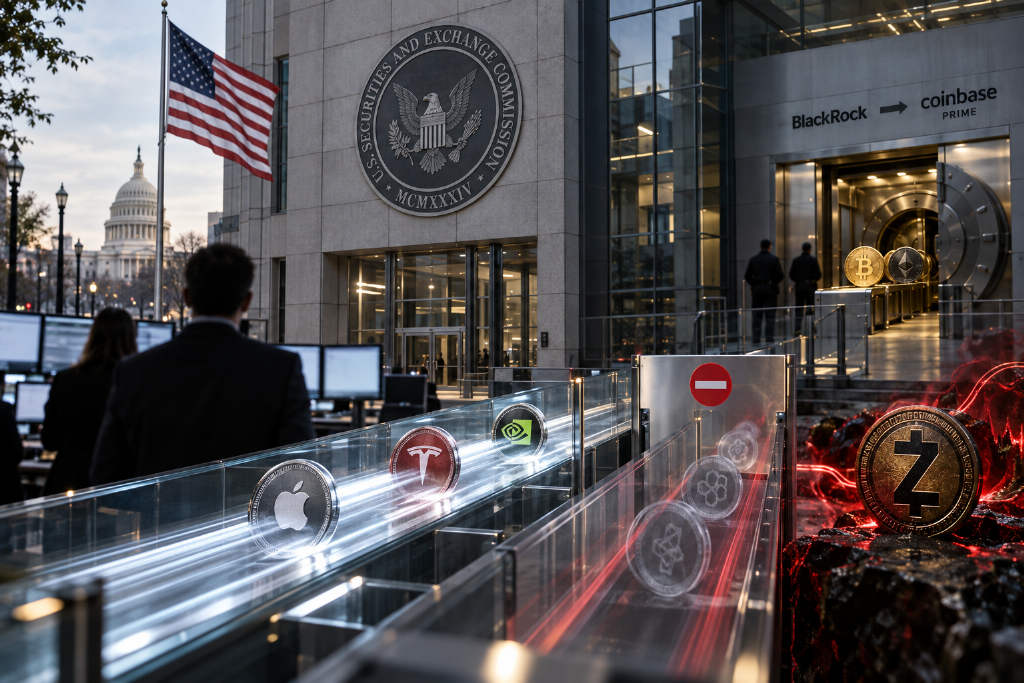
A dense wave of crypto, regulatory and macro headlines hit the market between Sept. 17 and Sept. 18. The U.S. Securities and Exchange Commission approved a temporary, conditional Innovation Exemption that allows limited trading of certain tokenized National Market System stocks on qualifying on-chain venues, while explicitly excluding synthetic products. The move came with strict conditions around issuer notice, investor rights, venue eligibility and sanctions compliance, and drew immediate reactions from SEC officials, Robinhood CEO Vlad Tenev and Uniswap founder Hayden Adams. At the same time, Zcash became one of the market’s most closely watched assets. ZEC briefly moved above $1,500, liquidations topped $65 million over 24 hours, and several newly created wallets withdrew tens of millions of dollars’ worth of ZEC from exchanges. Separate reports tracked a large ZEC long on Hyperliquid, a whale that closed a month-long OKX long for an estimated $8.29 million profit, and a major short seller facing roughly $30 million in unrealized losses. Elsewhere, BlackRock transferred about $285.5 million in BTC and ETH to Coinbase Prime, Zilliqa set Sept. 22 for its second exchange migration hard fork, S&P Global signed a deal to acquire OpenZeppelin, and multiple AI companies, exchanges and infrastructure projects announced product, financing and policy updates.

530
SEC opens a limited path for on-chain tokenized stocks as ZEC volatility and whale flows dominate Sept. 18 market watch
Policy and Re
2026-09-18 02:05:26

SEC unveils tokenized stock exemption as Atkins pushes longer U.S. stock trading hours

The U.S. Securities and Exchange Commission rolled out a temporary, conditional "Innovation Exemption" that allows limited on-chain trading of certain tokenized stocks through qualified tokenized securities venues, while setting guardrails that ban synthetic tokenized equities. SEC Chair Paul S. Atkins said the agency is also preparing for longer U.S. equity trading hours, arguing that tokenization could support real-time inventory management, improve efficiency, cut settlement failures, and reduce naked short-selling risk. The day’s broader crypto and market roundup also included Grayscale’s view that the latest Federal Reserve rate hike looks more like a mid-cycle adjustment than a major policy turn, new volume data from Hyperliquid’s HIP-3 markets, Ethereum’s Glamsterdam Devnet-11 rehearsal, an oracle attack on Nostra, MoonPay’s plan to use the $1.2 billion WTGXX tokenized money market fund in stablecoin reserve management, Robinhood Chain crossing 750 million transactions, and Tenka’s $2 million Pre-Seed financing led by Maven 11. Market data showed ZEC briefly topped $1,500 and set another all-time high, while major centralized exchange gainers included NEAR, ARB, UNI, and ZEC.

450
SEC unveils tokenized stock exemption as Atkins pushes longer U.S. stock trading hours
SEC
2026-09-18 05:00:35

SEC opens limited trading path for tokenized stocks through TSV exemption

The U.S. Securities and Exchange Commission has created a limited route for tokenized stock trading by granting a temporary, conditional “Innovation Exemption” for Tokenized Securities Venues, or TSVs. Under the framework, tokenized National Market System stocks may trade on approved on-chain venues, but only under strict conditions. TSVs must be U.S. entities, comply with Office of Foreign Assets Control sanctions rules, restrict access to eligible participants, and bar synthetic tokenized equities. Token holders must receive the same rights as traditional shareholders, including dividends and voting rights, while issuers retain the right to object and block trading of their securities on a TSV. The exemption takes effect immediately and runs for five years, to around September 2031, while the SEC seeks public comment on possible rule changes. The agency also set detailed limits on product design, trading halts, smart contract disclosure, and volume caps for Tier1 and Tier2 stocks. SEC Commissioner Hester M. Peirce separately outlined six open questions tied to overnight trading, disclosure timing, broker obligations, and investor protection. After the announcement, Robinhood CEO Vlad Tenev and AMC CEO Adam Aron both welcomed the framework, and several crypto assets tied to tokenization and DeFi posted gains.

370
SEC opens limited trading path for tokenized stocks through TSV exemption
3D DRAM
2026-09-14 11:09:11

3D DRAM race heats up as AMD, NAURA and memory giants push new architectures and process tools

Two developments in the first week of September 2026 put 3D DRAM back at the center of the memory industry. AMD disclosed internal test results for a Hybrid Bonding-based 3D DRAM architecture, saying energy efficiency could improve by as much as 17x versus conventional HBM stacks. Around the same time, Chinese semiconductor equipment maker NAURA published an IEEE paper describing a manufacturing advance for next-generation 3D DRAM, including a two-step cyclic etch process for 64-layer alternating silicon and silicon-germanium structures, structural uniformity above 95%, an etch selectivity above 500:1, and silicon loss below 10 angstroms in a 200 nm interlayer structure. The report argues that these announcements matter because conventional DRAM scaling is nearing physical and economic limits. It also reviews the two main technical paths now being pursued, 4F2 VCT and VS-CAT, and outlines how Samsung Electronics, SK hynix, and Micron are positioning themselves. Beyond chipmakers, the shift is also reshaping the equipment chain, from high-aspect-ratio etch to atomic layer deposition, wafer bonding, CMP, cleaning, inspection, coating and developing, testing, and high-purity process systems.

1090
3D DRAM race heats up as AMD, NAURA and memory giants push new architectures and process tools
CXMT
2026-09-09 00:23:43

CXMT starts HBM3 pilot production with initial yields at about 25%, report says

Chinese DRAM maker ChangXin Memory Technologies, or CXMT, has started pilot production of fourth-generation high-bandwidth memory HBM3, with initial yields stalled at 25%, according to a report by The Chosun Daily cited by ChainCatcher. The report said that level is roughly one-third of the 80% yield often seen as a target for mass production. SK Hynix has been mass-producing similar products since 2022, with yields above 90%. For CXMT’s 8-layer HBM3 stack, front-end process yields were reported at about 30%, while roughly 70% made it through the back-end process as final good units. The company has supplied a small number of samples to Chinese firms including Alibaba’s T-Head and Cambricon, and is continuing to improve yields. The report added that CXMT’s G4, a 17nm-class process, does not face major issues in conventional DRAM production, but HBM requires larger DRAM die and tighter electrical specifications. Industry sources in the report pointed to limited maturity in through-silicon via, or TSV, technology. Analysis from Nomad Semi said Samsung’s HBM2 has more than 5,000 TSVs per chip, SK Hynix’s HBM3 has more than 8,000, and CXMT has about 3,000, leaving the company 4 to 5 years behind Samsung and SK Hynix.

840
CXMT starts HBM3 pilot production with initial yields at about 25%, report says